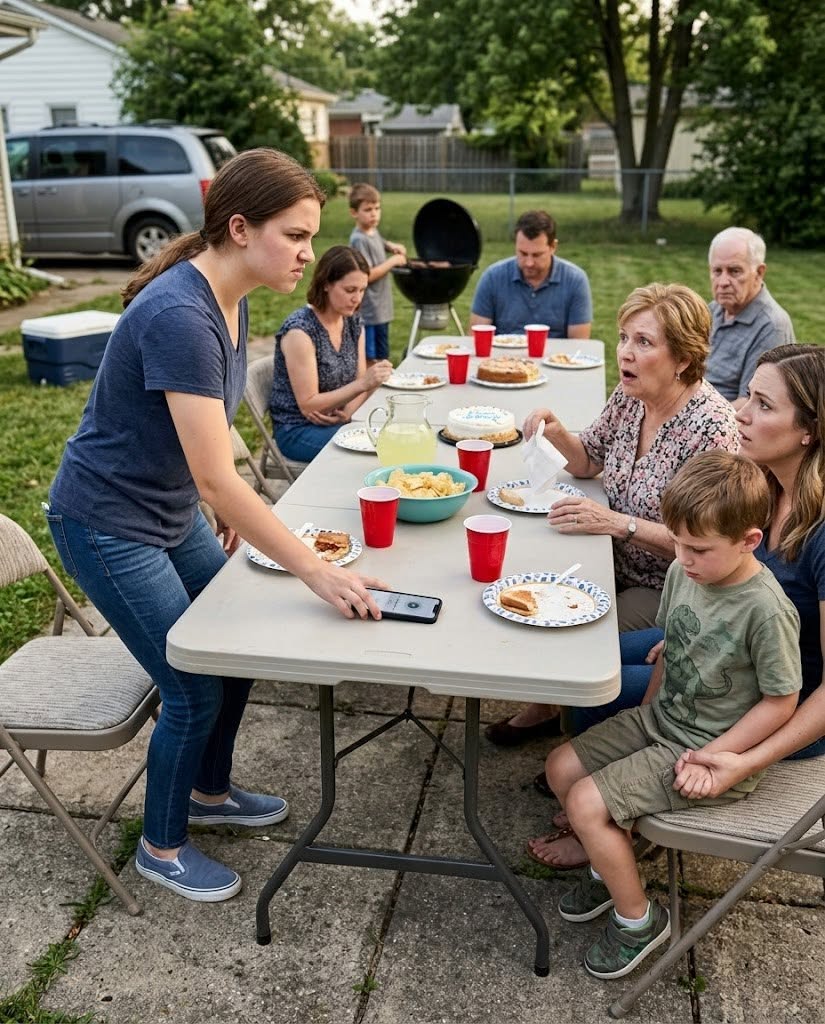
My dad pushed himself up from the head of the picnic table and came around to Lily’s side. He faced my mother, told her to sit, then motioned toward the phone. He had heard enough to know the message wasn’t finished. He wanted Lily to let the rest of it play.
For most of my life, my father had survived family conflict by becoming quieter than everyone else.
That afternoon, he didn’t.
And somehow, seeing him stand beside my seventeen-year-old daughter made the whole picnic feel different.
A few minutes earlier, I had been trying to leave.
I had Noah against my side, one arm around his shoulders, while Lily stood close enough for him to reach for her free hand. My mother had already accused us of ruining my father’s seventy-first birthday simply because I refused to let my children stay at a table where one of them had been publicly rejected.
I thought leaving was the cleanest thing I could do.
No speech. No screaming. No family vote.
Just go.
Then Dad stood up.
That mattered because everyone there knew his pattern.
He was the person who cleared his throat when an argument got too sharp. He was the person who waited for tempers to settle instead of choosing a side. He was the person who could sit at the head of a table while something cruel happened three feet away and convince himself that staying neutral kept the family together.
For years, that silence had benefited my mother.
She could make a cutting remark, and someone would change the subject.
She could embarrass somebody, and another relative would laugh too loudly.
She could say something that landed badly, then point to all the good things she did for everyone as proof that the hurtful part should not count.
She cooked for gatherings. She remembered birthdays. She could be funny, generous, organized, and warm when she wanted to be.
That was part of what made confronting her so difficult.
People like simple villains.
Families rarely get them.
Instead, they get people who can bring your favorite dish, remember exactly how you take your coffee, make a room laugh, and still know precisely where to place a sentence that will make a child feel unwanted.
Noah had been absorbing those sentences for longer than I wanted to admit.
He was eight.
Eight is old enough to notice who sighs when you sit beside them.
Eight is old enough to hear the difference between someone teasing you and someone wishing you were somewhere else.
Eight is old enough to start changing yourself before anybody asks.
That was what he had been doing all afternoon.
My father’s birthday picnic was supposed to be easy.
Burgers hissed over the grill. Lemonade sat in plastic pitchers long enough to lose its chill. Kids ran across the grass while adults crowded around folding tables with paper plates balanced near their elbows.
Noah wore his favorite dinosaur shirt.
He had noticed ants in the grass, so he stayed carefully on the bench instead of wandering around like the other kids.
He watched everything.
He watched where people stepped. He watched where drinks were placed. He watched whether his hands were in the way.
He was trying.
Earlier, my brother’s dog jumped on him and knocked over his lemonade.
Noah apologized.
Then he apologized again.
He had not caused the spill, but he helped clean the table while everyone else kept eating and laughing.
I remember looking at him then and feeling that small ache parents get when they realize their child is working harder than anyone else can see.
He wanted the adults to be pleased with him.
He wanted Grandma to be pleased with him.
He wanted to belong without becoming a problem first.
Then my mother looked across the table and said, “Next time, don’t bring the kid.”
She said it where everybody could hear.
My brothers heard.
My cousins heard.
My aunts heard.
My father heard.
Noah heard.
His plastic fork stopped halfway to his mouth.
For a second, I thought I must have misunderstood her because some part of me was still trained to search for the kinder interpretation.
So I asked her what she had said.
She didn’t take it back.
She didn’t soften it.
She wiped her mouth with a napkin and said the rest of us were already thinking it anyway.
According to her, Noah ruined the mood.
That sentence changed his whole body.
His face lost color.
His shoulders curled inward.
He lowered his fork so carefully that it barely touched the plate.
He was trying not to make noise after being told, in front of his own family, that his presence itself was too much.
I looked around the table.
My sister focused on her phone.
My brother suddenly had urgent business with a hot dog on the grill.
My father cleared his throat.
Nobody defended Noah.
That part stayed with me almost as much as my mother’s words.
Cruelty is loud when one person says it, but sometimes the deeper wound comes from counting how many people heard and decided staying comfortable mattered more.
I was about to answer her when the chair beside me scraped hard across the pavement.
Lily stood.
My daughter had always hated confrontation.
She chose words carefully. She avoided being the center of attention. If an argument started getting loud, Lily was usually the person who became quieter, not louder.
But she put both hands on that folding table and looked straight at her grandmother.
“Say that again.”
My mother blinked at her.
Lily didn’t retreat.
She told Grandma to look directly at Noah and repeat what she meant: that he should not be included in family events because his presence made her uncomfortable.
My aunt tried to warn Lily off.
Lily said no.
Her voice shook.
Her hands stayed planted.
Her point was simple: everyone kept pretending Grandma didn’t mean the things she said, but Noah knew better.
He always knew.
Under the table, I reached for my son’s hand.
He squeezed mine so tightly it hurt.
My mother tried to put Lily back in her place by reminding her that she was seventeen and calling the argument an adult conversation.
Lily answered that the conversation had stopped belonging only to adults the moment an eight-year-old was humiliated in front of an entire family.
The grill kept crackling behind us.
A cooler lid slammed somewhere near the driveway.
No one turned.
Then Lily reached for the backpack hanging from her chair.
That was the moment my mother’s expression shifted.
Not panic.
Recognition.
I saw it before I understood it.
Lily opened the backpack and took out her phone.
She unlocked it, set it in the center of the table, and brought up an audio file dated three nights earlier.
My mother stared at the screen.
Lily rested a finger near the control and explained that Grandma had already spoken to her privately about Noah.
That was when I understood this confrontation had not begun at the picnic.
Lily had arrived carrying something.
She had been sitting beside me through the burgers, the lemonade, the dog knocking over Noah’s drink, and all of his nervous little apologies while knowing Grandma had already tried to make her part of something.
My mother’s napkin slipped from her hand.
Lily started the recording.
The voice that came through the phone was unmistakably my mother’s.
It was calm.
That calmness made it worse.
There was no heat-of-the-moment frustration to blame. No chaotic picnic noise. No excuse that she had been irritated and said something careless.
The message had been left three nights before the birthday.
In it, Grandma asked Lily to help convince me that Noah should not be included in every family gathering.
She described his presence as something that made other people uncomfortable and framed my father’s birthday as an occasion that should focus on family rather than on dealing with Noah.
The meaning was impossible to miss.
Noah was sitting there listening to proof that his grandmother had been discussing how to exclude him before he ever put on his dinosaur shirt that afternoon.
His hand changed inside mine.
The tight grip disappeared.
His fingers went slack.
That frightened me more than if he had started crying.
My mother immediately attacked the recording instead of what she had said.
She demanded that Lily turn it off and accused her of secretly recording a private conversation.
But Lily had not secretly recorded Grandma.
Grandma had called her.
Lily had not answered.
The words everyone was hearing had been left for her as a message.
There was no complicated explanation for how Lily had gotten it.
Grandma had delivered it to her herself.
The excuse collapsed almost as soon as it was offered.
Around the table, people finally began looking up.
My brother stopped pretending the grill needed all of his attention.
My sister lowered her phone.
My aunt, who had softly warned Lily only minutes earlier, looked directly at Noah.
It should not have taken a recording.
That thought hit me hard.
My son’s face should have been enough.
His grandmother’s public words should have been enough.
His folded shoulders should have been enough.
But families can become strangely skilled at explaining away what they do not want to confront.
A child’s reaction can be called sensitivity.
A cruel sentence can be called humor.
A pattern can be called a misunderstanding.
A recording is harder to turn into something else.
For years, I had watched smaller comments disappear into that family machinery.
Grandma was just joking.
Grandma was tired.
Grandma didn’t mean it like that.
Grandma does so much for everyone.
Every explanation required the hurt person to carry more of the burden than the person who caused the hurt.
And because Noah was a child, he had no power to challenge the story adults told about what he was experiencing.
Lily changed that.
She was seventeen, but she understood something the rest of us had avoided: Noah did not need another private apology later. He needed someone to interrupt the humiliation while it was happening.
She did.
She stood when the adults stayed seated.
She spoke when the adults looked away.
She brought proof only after Grandma tried to dismiss what Noah already knew was true.
Then I stood too.
I pulled Noah against me and said we were leaving.
I was not trying to win the table anymore.
That mattered.
For too many years, dealing with my mother had meant trying to find the exact sentence that would finally make her understand why something hurt.
That day, I stopped waiting for understanding before setting a boundary.
My mother immediately made my father’s birthday the issue.
If I left with the kids, she said, then I was the one ruining the celebration.
The accusation would have worked on me once.
Maybe it had worked many times.
Keep the peace.
Stay until dessert.
Don’t make Dad’s birthday awkward.
Talk about it privately.
Think about everybody else.
But Noah had already been thinking about everybody else all afternoon.
He had apologized for a drink the dog knocked over.
He had cleaned a mess he did not create.
He had sat carefully because of ants in the grass.
He had tried to eat quietly.
He had tried to take up less space.
An eight-year-old had already spent enough of the day managing adults’ comfort.
So I told my mother I was not destroying my father’s birthday.
I was ending the expectation that my children had to earn basic treatment as family.
Lily picked up her phone and came beside us.
Noah still didn’t speak.
He reached for Lily’s free hand.
That small movement nearly broke me.
He did not reach toward the adults who had stayed silent.
He reached toward the sister who had stood up.
Children notice where safety moves.
Then Dad moved too.
For seventy-one years, conflict had usually made him retreat into quiet.
This time, he pushed his chair back.
He came around the table.
He stopped beside Lily.
He faced my mother.
The shift was not dramatic in the way family stories sometimes become dramatic when they are retold.
He did not pound the table.
He did not shout over anyone.
He did not deliver some perfect speech that magically repaired years of silence.
He simply stopped being neutral.
My mother looked at him as if she had not expected resistance from that direction.
He indicated Lily’s phone.
What he had heard had already told him this was bigger than one ugly sentence at a birthday picnic.
The message had begun before the picnic. Lily had been pulled into it before the rest of us knew anything was happening. Noah’s exclusion had been discussed as a plan, not just blurted out as irritation.
And Dad understood there was still more audio.
For the first time that afternoon, my mother was not controlling whether the subject changed.
My brother was watching.
My sister was watching.
My aunt was watching.
Noah was between Lily and me.
Lily’s phone was in her hand.
Dad stayed beside her.
My mother had spent years depending on the family’s instinct to smooth things over before anyone examined them too closely.
Now no one was smoothing anything over.
The burgers could burn.
The lemonade could keep getting warm.
The birthday could become uncomfortable.
Dad had finally decided that discomfort was not the worst thing that could happen at his table.
Making his grandson feel unwanted was worse.
And the part that changed me most was how little ceremony it took.
A chair pushed back.
A man walking around a folding table.
A grandfather choosing where to stand.
That was all.
But Noah saw it.
So did I.
So did my mother.
Lily looked down at the phone again.
Her thumb hovered over the control while Dad remained at her shoulder, waiting for the message Grandma had left three nights earlier to continue.
