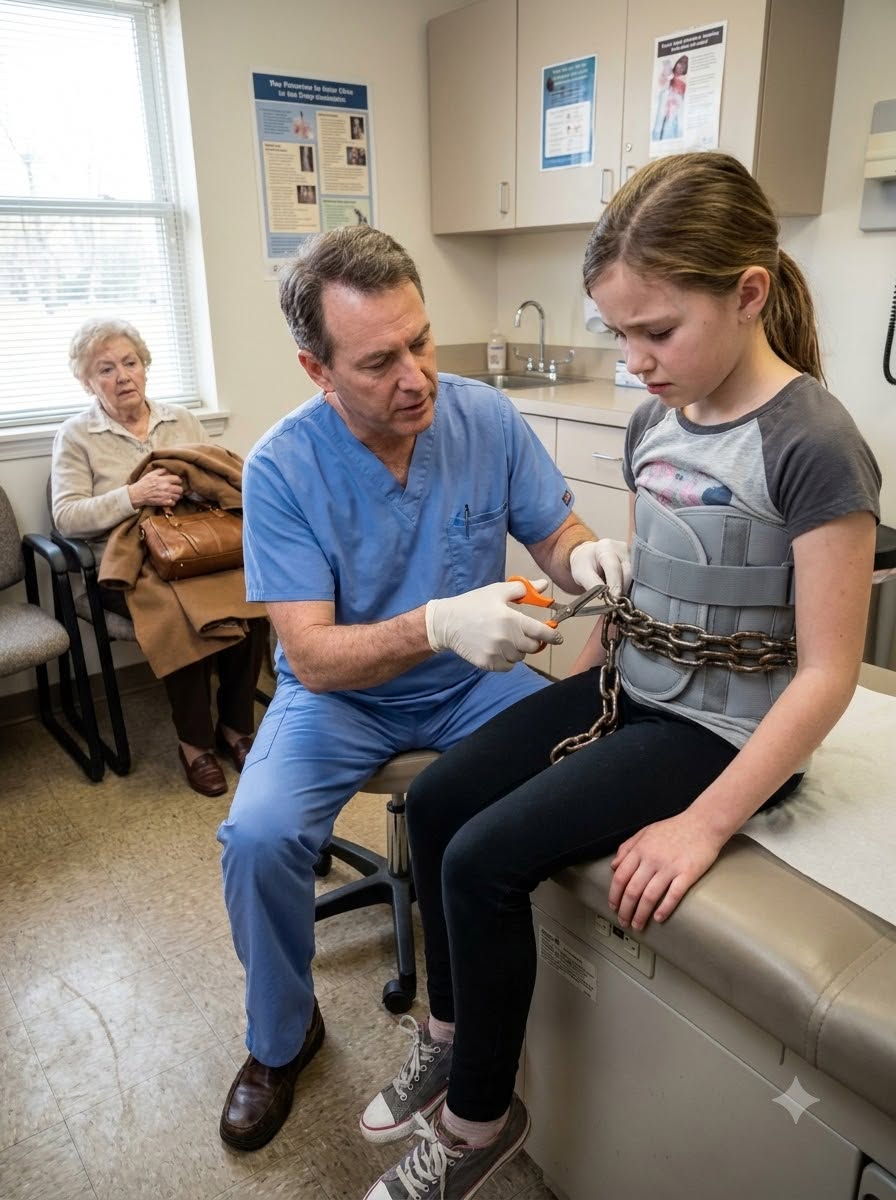
I was ten when Nana carried me into a small prairie clinic with my back brace secured by a tiny steel padlock.
“Disobedient children stay right where they’re placed,” Nana said, looking the receptionist in the eye while refusing to hand over the key.
When the surgeon cut it away and the hidden metal chain hit the linoleum floor, I looked up and asked whether I finally had permission to breathe again.
The clinic room smelled like sharp bleach and burnt filter coffee, and I hadn’t eaten a single bite of breakfast because Nana insisted that children who complained before medical appointments didn’t need food making them sick on the drive.
My ribs throbbed where the stiff plastic brace had rubbed against my skin for weeks without relief.
I stayed completely still on the exam table because moving made the pressure worse.
The surgeon, Dr. Shepherd, crouched beside the severed plastic and lifted one end of the chain without letting his gloves touch my bare skin.
Behind him, a big black fly kept tapping relentlessly against the screen in the open window.
Nana folded my winter coat neatly across her lap, smoothing down the wool with both hands.
“She takes it off whenever my back is turned,” Nana said, shaking her head. “I hate having to be so strict, but she doesn’t understand what’s good for her.”
Dr. Shepherd looked directly at me.
“Do you take it off, standard practice or not?” Dr. Shepherd asked gently.
I shook my head slowly, keeping my eyes fixed on his name tag.
Nana reached over and smoothed my hair behind my ear as if we were posing for a family picture.
“She gets embarrassed easily,” Nana told him with a light laugh. “You know how young girls are about these things.”
Before he could ask another question, I reached up and pointed to the dark purple mark below my left arm where the chain had pressed straight through my thin undershirt.
Dr. Shepherd’s hand stopped instantly in midair as he examined the bruise.
For months, Nana had called the brace my seat belt whenever neighbors asked about it.
She told everyone in town that I wandered off whenever I was left alone.
The wandering had actually happened just once, late one evening after supper, when I walked down our long gravel driveway to the mailbox because I saw the red metal flag was still up.
Nana found me before I even reached the post.
After that evening, she told Dad that I couldn’t be trusted anywhere near the main road, and I never corrected the story when he came home exhausted from his shifts.
That silence was my choice, a quiet way to keep the peace at home.
Earlier that same week, the elementary school nurse had pulled me aside to ask whether the back brace hurt.
“Does that plastic dig into you, sweetheart?” the nurse had asked.
“No, it feels totally fine,” I told her, staring straight ahead.
Nana had been standing directly behind my chair with one heavy hand resting on my shoulder, but I had still managed to say the words without shaking.
The school nurse wrote something down in her binder, and I walked silently back to my classroom.
Now Dr. Shepherd turned around and asked Nana directly how long she had been locking the heavy brace onto my body.
“Locking is such an ugly word to use,” Nana replied smoothly. “I am simply keeping my granddaughter safe.”
“How long has this lock been on her?” Dr. Shepherd asked again, his voice dropping into a stern tone.
Nana reached deep into her leather purse, pulled out a white paper tissue, folded it twice, and placed it right back inside without using it.
“Just a little while,” Nana said, shifting in her chair.
Dr. Shepherd walked straight to the door and told the receptionist to dial my father’s work phone immediately.
Nana’s fingers tightened sharply around the fabric of my coat.
“That isn’t necessary at all,” Nana said, her voice rising.
“It is entirely necessary now,” Dr. Shepherd answered, standing by the doorway.
Nana reached into her purse again and handed me half a stale package of saltine crackers while we waited in silence.
I ate all four crackers right away even though my mouth was completely dry and scratchy.
For the next twenty minutes, Nana talked casually about ordinary chores, asking about the laundry, Dad’s work schedule, and whether the heavy rain would ruin her garden tomatoes, acting as if the cut chain were not lying in two pieces right on the metal table.
Then she leaned close to my ear.
“You’re making your father leave work early for this nonsense,” Nana whispered.
I stared down at the floor tile, refusing to answer her.
One of my white socks had twisted uncomfortably under my heel, and I tried to fix it without bending my torso enough to hurt my bruised ribs.
When Dad finally rushed through the clinic door, there was pale pine sawdust caught in the cuffs of his work shirt and one bootlace was trailing behind him.
Nana stood up immediately from her chair.
“She worked herself up into a complete state again,” Nana said, stepping toward him.
Dad looked at my face, then down at the pieces of plastic on the table.
“Did she try to run off again?” Dad asked, his forehead creased with worry.
I knew that exact question because I had heard it a hundred times before.
Nana answered before I could even open my mouth.
“She’s been difficult and uncooperative all morning long,” Nana said, crossing her arms.
Dr. Shepherd reached over and picked up the two cut links of the iron chain.
Dad blinked hard as he stared at the metal.
“What on earth is that?” Dad asked, his voice shaking slightly.
Nana’s tone instantly softened into a gentle murmur.
“It’s the only thing that keeps her from wandering off and hurting herself,” Nana said.
Dad rubbed both of his broad hands over his face in total exhaustion.
I fully expected him to turn around and apologize to her for making a fuss.
Instead, Dad looked down at me and asked where the key was kept.
“Nana has the key in her bag,” I said clearly.
Nana gave a small, nervous laugh and shook her head.
“The child loses everything she touches,” Nana said.
“I’ve never had the key in my hands,” I told my father, looking him dead in the eye.
Dad turned his head slowly and looked at his mother.
For the very first time that morning, Nana did not reach out to touch my arm or shoulder.
Dr. Shepherd asked Dad whether he had personally known that the back brace was being secured with a brass padlock every day.
Dad said he knew the brace was supposed to stay on for my spinal alignment, but he looked completely confused by the hardware.
Then Dr. Shepherd asked who had convinced him that the padlock itself was a standard medical requirement.
Dad turned his head toward Nana with a sudden realization.
“Mom, you specifically told me that this lock came straight from the medical clinic,” Dad said, his voice dropping an octave.
PART 2
Nana didn’t even bother to deny telling him that story.
“I said the clinic wanted the brace kept on continuously,” Nana said defensively. “You were the one who interpreted that as needing a lock.”
Dr. Shepherd held up the heavy cut padlock so the sunlight caught the jagged metal edge.
“We do not lock medical braces under any circumstances,” Dr. Shepherd said firmly. “We never provided this hardware to your family.”
Dad looked back and forth between the doctor and his mother, and Nana immediately started talking over everyone about my personal safety.
“She walked straight toward the busy road,” Nana said, pointing a finger at me. “You were stuck at work all day. I was the only adult here, so somebody had to take responsibility.”
Dad’s face hardened noticeably the second she mentioned his job at the lumber yard.
Nana noticed the shift in his posture right away and pushed harder.
“Fine then,” Nana said bitterly. “Take over everything yourself from now on, and you can explain to the sawmill management why you suddenly can’t work early morning shifts.”
There was the real threat hanging over our heads.
Without Nana staying at the house, Dad had nobody to get me ready for school, drive me to medical appointments, or watch me when his morning shift started long before sunrise.
Nurse Brenda quietly stepped into the room and suggested that maybe everyone should go home to cool down before making big decisions.
Nana reached across the table to grab my coat.
I pulled the wool coat right off her lap and dropped it onto Dr. Shepherd’s empty swivel chair.
“No,” I said, looking straight at my father.
Dad stared at me in surprise.
I took a deep breath and told him about what happened with the elementary school nurse earlier that week.
“I told her the brace didn’t hurt me at all,” I confessed, my voice trembling slightly.
Nana nodded quickly, looking at Dad as if she had just been proven right.
“See how she makes things up?” Nana chimed in.
“I only said that because she was standing directly behind my chair holding my shoulder,” I said, pointing at Nana.
Dad knelt down beside me and asked why I hadn’t brought any of this up at home.
I stared down at the salty cracker crumbs crushed into my sweaty palm.
“Because you get into huge trouble whenever you miss a shift at work,” I whispered.
He didn’t offer a quick excuse or answer that statement.
Instead, Dad walked over to the front counter and asked the receptionist for the medical-consent form that authorized Nana to bring me to clinic appointments.
Nana hurried over and told him not to be completely ridiculous over a small misunderstanding.
Dad took the pen, drew a thick ink line right through her full name, signed his signature beside the correction, and handed the clipboard straight back to the receptionist.
Then he grabbed my hand, left Nana standing alone in the middle of the waiting room, and led me out to the parking lot.
PART 3
Dad guided me past Nana and straight through the heavy clinic door while she remained standing near the front desk, and I tightly carried the brown paper bag holding the two cut pieces of heavy chain.
Outside, the cool morning air felt much colder against my bare neck than it should have, and I opened the passenger door of Dad’s pickup truck without waiting for him to unlock it for me.
My stomach cramped sharply before he even inserted the key into the ignition, so when he asked whether I wanted to stop for breakfast, I nodded quickly instead of telling him I was fine.
He pulled into a gas station off the state highway, bought me a warm sausage biscuit and a bottle of orange juice, and I ate the biscuit immediately because the hot meat burned the roof of my mouth in a satisfying way.
Dad did not purchase anything for himself.
I noticed that right away.
For several long minutes, I watched big freight trucks pull in and out of the station while the brown paper bag rested between us on the torn vinyl seat, making a soft scraping noise whenever the truck idling caused the cab to shake.
Then Dad slowly reached his right hand toward the bag.
I placed my small hand over the paper bag first, stopping his movement.
“Can I keep this?” I asked softly.
He looked at me with a pained expression.
“You mean the cut chain?” Dad asked.
I nodded my head once.
He lowered his hand back to the steering wheel.
“Yeah, you can keep it,” Dad said quietly.
I kept the bag resting against my leg.
I kept eating my breakfast in small bites.
I kept waiting for him to tell me that I had completely misunderstood Nana’s intentions, because the adults in my life had been correcting my memory for so long that silence always felt like a temporary delay before a lecture.
When he finally spoke, he asked me how many times Nana had actually locked the heavy brace onto my ribs.
I counted backward in my head through cold mornings, doctor appointments, bath times, and quiet nights when she had checked the plastic straps before switching off my bedroom light.
“I don’t really know,” I whispered, looking out the side window.
Dad stared blankly through the front windshield at the gas pumps.
I added softly, “It was a lot of times.”
He used his thumb to rub the pale yellow pine sawdust from his shirt cuff until the wood dust collected in a neat line on his denim jeans.
“Did she lock the metal chain at night while you were sleeping too?” Dad asked, his voice barely audible over the engine fan.
I chose not to protect his feelings from the real answer.
“Yes, every night,” I said.
His thumb stopped moving against his jeans.
I took a sip of the orange juice, even though the citrus tasted far too sweet in my dry throat, and told him that Nana always kept the little brass key on a separate ring inside the front pocket of her purse.
Sometimes she would purposefully let me hear the keys jingle outside my bedroom door before turning off the hallway light.
Dad turned his head quickly to look at me.
“She actually showed you the key?” Dad asked, his eyes widening.
“No, she never showed it to me,” I explained, folding the greasy biscuit wrapper into smaller and smaller squares on my lap. “I just knew what it was because I could hear the metal jingling whenever she walked down the dark hallway.”
The truck engine remained turned off.
A heavy refrigeration unit hummed loudly through the gas station wall behind the parking spots, and someone had dropped a single grease-stained work glove right beside the concrete curb.
Dad gripped the steering wheel tight and finally spoke.
“I should’ve asked you what was happening,” Dad said, looking at his hands.
I could have agreed with him right then and made him feel worse.
Instead, I looked at his profile and said, “I should’ve told you the truth earlier.”
He shook his head once to reject my blame, but I turned my face toward the side window before he could say anything to make the moment easier for either of us.
By the time we pulled into our gravel driveway, sometime just before noon, Nana’s sedan was not parked in the yard yet, so I followed Dad up the wooden steps and went straight into the kitchen.
The small house smelled strongly of green tomato plants that Nana had brought inside from the back porch because she was convinced the evening air was getting too chilly for the crops.
Dad pulled the original spine brace instruction booklet from the cluttered drawer where he kept appliance warranties, school notices, and grocery coupons he never used, and I pulled out the chair directly across from him.
He read through every single page of text.
Then he flipped back to the beginning and read them all over again.
Nowhere in the entire booklet did the medical text mention a padlocking mechanism.
Nowhere did the diagrams mention an iron chain.
Nowhere did the instructions state that a young child should be physically unable to unbuckle the brace in an emergency situation.
I watched his thick index finger trace a paragraph near the bottom of the page that explained how parents were supposed to regularly check the skin for deep red pressure marks, and I knew he had reached the warnings about skin tissue before he even raised his eyes to look at the dark bruise near my ribs.
“Did she ever see this mark on your skin?” Dad asked, pointing toward my left side.
I nodded my head slowly.
“What did she say when you showed it to her?” Dad asked, his jaw tightening.
I picked a stray bread crumb off the formica tabletop that had probably been sitting there since our quick breakfast the morning before.
“She said I was deliberately rubbing my body against the plastic to cause trouble,” I said quietly.
Dad closed the paper booklet with a sharp snap.
The front screen door banged open before he could say another word.
I stayed seated right in my chair, keeping my posture straight.
Nana walked straight into the kitchen holding her leather purse and my wool coat, which the receptionist at the clinic must have handed to her after we walked out, and she draped the coat over the back of my chair as carefully as if the entire morning had gone according to plan.
“I certainly hope everybody in this house is feeling much calmer now,” Nana said, smoothing her blouse.
I reached behind me, picked up the coat, and laid it neatly on the empty table beside me.
Dad stood up and asked her for her set of house keys.
Nana blinked rapidly in surprise.
“What did you just say?” Nana asked, stopping in her tracks.
“I want the key to this house back right now,” Dad repeated, extending his open palm.
I kept my eyes fixed on Dad’s face instead of looking at her.
Nana set her purse down heavily on the kitchen counter and told him he was being absurdly dramatic over nothing, reminding him that she had held that house key for nearly a decade, that she drove over every single morning because his shift at the sawmill started before sunrise, and that taking her key away would only end up punishing himself.
Dad held his hand completely still in the air between them.
I waited to see if he would break.
Nana kept talking without taking a breath.
She listed off every favor she had ever done, mentioning his early shifts, the mornings he left while I was still sound asleep, the doctor appointments thirty miles away in the next county, the school snow days, the stomach bugs, and the freezing morning his truck battery had died back in January.
I heard every single example as a valid reason why he might give up and lower his hand.
He did not lower his arm an inch.
After a long minute of silence, Nana finally unzipped her purse.
The keys made that familiar sharp metallic sound as she pulled them out of the leather pocket.
My shoulder muscles tightened automatically before I could stop myself, and I forced myself to keep watching while she unhooked one shiny silver key from the brass ring.
Dad saw the sudden flinch across my face.
Nana saw it too.
Her fingers closed tightly around the rest of the key ring.
“Does that tiny noise actually bother you now?” Nana asked me, her voice dripping with sarcasm.
I said absolutely nothing to her.
Dad took the silver house key directly from her palm.
Then he looked her in the eye and asked for the smaller key as well.
Nana’s confident expression changed instantly.
I knew exactly which key he was talking about.
She pretended that she had no idea what he meant.
“The padlock key,” Dad said, his voice cold and steady.
Nana opened a small zippered side pocket inside her purse and slowly moved old receipts, folded tissues, and a small tube of hand lotion from one side to the other while I watched her every move.
She finally found the small brass key resting at the bottom of the lining.
For a split second, she held the tiny piece of metal between her thumb and forefinger.
Then she dropped it directly onto the table.
The small key made a tiny clicking sound against the wood.
I reached down into my lap, pulled the brown paper bag from the clinic out, and set it right beside the small key.
Nana looked down at me with cold eyes.
“I did every single thing this past year because somebody had to keep you safe from yourself,” Nana said, her voice shaking with anger.
I moved my hand completely away from the paper bag.
Dad told her to pack up her things and go home immediately.
She gave a short, bitter laugh that had no humor in it at all, and I chose to keep staring directly at her face when she told Dad that he would be crawling back to call her before his very next shift began.
“Do you honestly think the management at the lumber mill gives a damn about your domestic issues?” Nana asked him, leaning forward. “Do you think they’re going to alter their entire production line schedule just because you suddenly decided to play full-time father?”
Dad’s jaw muscles clenched tightly, but he didn’t counter her argument.
Nana picked up her heavy purse from the counter.
Before stepping out the back door, she turned around and told me she hoped I fully understood the terrible chain of events I had just started in our family.
I looked her dead in the eye and answered her directly.
“I do understand,” I said clearly.
She paused near the doorframe as if waiting for me to apologize.
I did not add a single word.
After the back door slammed shut, Dad walked over, turned the deadbolt lock, and set her silver house key right beside the tiny brass padlock key on the table, and then I watched him reach across the wall for the landline telephone receiver.
His scheduled shift the very next morning began at precisely 5:37 AM.
He dialed the main office at the lumber mill.
I sat completely still at the kitchen table while he tried to explain to his supervisor that he needed to report late for the next few days, and I could easily tell from the long, heavy silences between his short answers that the manager on the other end of the line was not making the request easy for him.
When Dad finally hung up the phone, he had lost his early-shift attendance bonus for the entire week along with the mandatory Saturday overtime hours he had been relying on to cover our expenses.
I knew exactly what losing overtime meant for our household budget.
It meant the electric utility bill sat on the counter unpaid for an extra two weeks.
It meant we bought cheap canned stew instead of fresh meat that wasn’t on sale at the grocer.
It meant Dad sat at the kitchen table late at night with three overdue notices, an old solar calculator, and a pencil long after he thought I was asleep.
I took the crushed saltine cracker wrapper out of my wool coat pocket and smoothed the plastic flat against the tabletop.
“You can call Nana and ask her to come back,” I said softly.
Dad looked at me for a long time without blinking.
“No, I am not doing that,” Dad said.
I swept the flat wrapper off the table and tossed it into the trash bin.
That same afternoon, he drove me right back to the elementary school even though there were only two hours remaining in the school day, simply because I told him I really wanted to go back to class.
The long school hallway smelled strongly of pine floor wax and industrial disinfectant, and the building heat had been turned up way too high despite the mild autumn weather outside.
When we reached the health clinic room, I turned around and asked Dad to wait for me in the hallway bench.
He nodded and sat down without arguing.
The school nurse recognized my face the second I walked through the door, and I sat on the paper-covered edge of the examination cot while she pulled out the medical log page where she had noted down our earlier conversation about my brace.
“I told you earlier this week that the brace didn’t hurt me,” I said, looking at her desk.
She nodded her head slowly. “I remember, sweetheart.”
I rubbed the outer seam of my blue jeans with my thumb.
“I only said that because my grandma was standing right behind my chair holding my shoulder,” I whispered.
The nurse’s pen stopped moving across the paper.
I told her everything about the tiny brass padlock.
I told her about the cut iron chain.
I told her that I had been completely unable to take the heavy plastic brace off by myself, even when the edges pinched my ribs raw or when I felt sick to my stomach at night.
When I finished talking, I asked her to write every single detail down in her official logbook this time.
She picked up her pen and wrote down every sentence I said.
I watched every single black ink word appear on the white page.
On the slow drive back home that afternoon, Dad asked me what I had discussed with the nurse, and I gave him the shortest version possible.
“I told her everything that happened,” I said.
He nodded his head once and kept his eyes on the road.
For the next several days, our morning routine became significantly worse before it showed any signs of getting better.
Dad woke me up at 4:58 AM every single day because he had spent years sneaking out of the house quietly for work and had no idea how long it actually took a ten-year-old child to eat cereal, find clean clothes, brush long tangled hair, and get ready for school without Nana barking orders at every step.
I poured way too much milk into my cereal bowl on the first morning and made a mess.
I knocked over a glass of water on the second morning.
On the third morning, Dad completely burned our toast while trying to pack a brown paper bag lunch for me, and I ate the dark burnt edges without complaining because we had no time left to make a replacement slice.
Yet, despite the chaotic mornings, nothing terrible actually happened to us.
That realized fact genuinely surprised me.
I started laying out my school clothes on the chair the night before because I wanted ten extra minutes of sleep in the morning, and Dad started leaving the small hallway light on low so I could navigate my way to the bathroom without stumbling in the dark.
By the end of that rough week, we had established a chaotic routine that was far from perfect, but it belonged entirely to the two of us.
Then the lumber mill management abruptly changed his temporary work schedule again.
Dad came home on Friday evening with a folded white paper notice tucked into his front shirt pocket and set it beside his dinner plate while I pushed my green peas around my plate with a fork.
Starting bright and early on Monday morning, he was required to report for his original 5:30 AM shift or forfeit his permanent spot on the main crew.
I read through the typed notice twice to make sure I understood the words.
This time, Nana did not need to be standing in our kitchen for me to hear her smug voice making her argument.
Dad sat by the kitchen counter and dialed her number that evening.
I stood quietly in the dark hallway near the door and listened even though I knew I should have walked away.
“Can you come over just on Monday morning?” Dad asked into the receiver, his voice tight. “Just Monday morning, Mom, until I can arrange a permanent sitter.”
My blood went cold as I listened.
When he finally hung up the phone, he turned around and found me standing near the bottom of the stairs.
“She promised she won’t even touch the back brace,” Dad said, trying to reassure me.
I stared at him without saying a word.
“She won’t be left alone with you for more than twenty minutes,” Dad added, rubbing his forehead.
I kept staring straight into his eyes.
He rubbed both of his hands over his exhausted face.
“I have to keep this job,” Dad whispered softly.
I turned around, walked into my bedroom, and closed the wooden door behind me.
For twenty minutes, I frantically tried to pack everything I thought I might need for school into my canvas backpack, including two heavy library books I had already finished reading and an old plastic hair comb with three missing teeth.
The repetitive packing motion did nothing to calm my racing heart.
I dumped everything out on the bed and unpacked it all over again.
At 8:16 PM, Dad knocked softly on my bedroom door.
“Come in,” I said.
He opened the door, but instead of walking in and sitting on the bed, he sat right down on the floorboards in the doorway, and I chose to sit down on the floor on the other side of the frame.
“I called her back a minute ago,” Dad said, looking at the floorboards between us.
I waited in complete silence for him to finish.
“I told her not to come over on Monday,” Dad said softly.
I looked down at his leather work boots.
“What are you going to do about Monday morning then?” I asked.
“I’ll figure out a way to deal with Monday,” Dad answered.
That simple answer didn’t magically fix his work schedule, our tight money problems, or the harsh reality that his entire employment was built around the assumption that Nana would always be available to cover his early hours.
But that night, I slept soundly without waking up to listen for the sound of jingling keys in the hallway.
On Monday morning, Dad reported to the lumber mill late.
He lost another shift premium payment on his paycheck.
I knew it happened because the following Friday night he placed two utility bills directly into the counter drawer without paying them, and I chose not to let him know that I had seen him do it.
The following week, his shift supervisor finally moved him to a late-morning crew for the rest of the month, which permanently solved our early morning schedule problem, but the new shift offered fewer total hours and required him to work until after dark every night.
We adapted to the new routine once again.
I ate my breakfast alone at the table while he took a quick shower.
I checked my own backpack to make sure my homework was signed.
I learned firsthand that nobody needed to stand behind my chair while I put on my shoes and socks.
Sometime during that long month, Nana started calling our house phone in the late evenings.
At first, I let Dad handle all of the phone calls.
She never directly asked to come back and take care of me.
Instead, she asked if he was eating properly.
She asked if my school grades were dropping because of the chaotic house.
She asked if he had remembered my upcoming medical follow-up at the clinic.
The most important sentence remained completely unsaid during every conversation.
One Tuesday night, Dad held the black phone receiver out toward me.
“She wants to say hello to you,” Dad said gently.
I shook my head firmly and stepped backward.
He brought the receiver back up to his ear.
“She said no, Mom,” Dad said into the phone, his voice steady and calm.
I walked into the kitchen, opened the refrigerator door, and looked inside even though I wasn’t hungry at all.
At my next official clinic appointment a month later, Dad took the morning off to come with me.
The waiting room felt much warmer than it had during our last visit, and someone had replaced the old burnt filter coffee with a fresh pot that smelled slightly better.
I picked out a vinyl chair where I could clearly see the long hallway leading directly to the examination rooms.
When Dr. Shepherd finally walked out and called my name, I stood up and carried my own wool coat in my arms.
He examined the dark pressure mark under my left arm first thing.
The deep purple bruise was fading into a faint yellow mark on my skin.
I explained to him exactly where the hard plastic brace still rubbed against my ribs and where it felt comfortable, and when he asked whether I was able to remove the device without adult assistance, I decided to show him right there.
I unbuckled the top strap.
I unhooked the middle fastener.
I lifted the plastic brace completely away from my chest.
Then I carefully positioned it back over my undershirt and strapped it secure.
No heavy metal chain hit the floor this time.
Dr. Shepherd adjusted a small foam pad near my lower ribs with a pair of pliers and had me try the straps again, and I chose to tell him that it still pinched my skin slightly instead of pretending everything was fine just to end the appointment quickly.
He adjusted the foam pad a second time.
“How does that feel now?” Dr. Shepherd asked, looking at me.
“It feels a lot better,” I told him honestly.
Dad stayed completely quiet while standing against the clinic wall, watching us work.
After the appointment was over, Dad bought a package of peanut butter crackers from the waiting room vending machine because lunch was still an hour away, and I ate two of them before slipping the rest of the package into my coat pocket.
Neither of us made any mention of the first package of saltine crackers Nana had handed me in that same clinic.
We didn’t need to bring it up.
The much harder part of our new life happened back at home over the next several months, because removing Nana from my medical appointments was simple compared to erasing her distorted version of my personality from Dad’s mind.
Sometimes he would still anxiously ask whether I was going to wander off toward the road if I went outside to play in the yard alone.
The first time he asked, I felt hurt and immediately walked back inside the house.
The second time he asked, I stood my ground on the porch and corrected his memory.
“I only walked down to the mailbox one single time,” I said clearly.
He looked genuinely embarrassed by his own question.
I kept going before he could change the subject.
“I wasn’t trying to run away from home,” I told him.
“I know that now,” Dad said softly.
“No, you actually know it now,” I repeated.
Dad nodded his head in quiet agreement.
After that conversation, he stopped asking if I was going to run away and simply asked where I was planning to ride my bike.
I answered his questions honestly every single time.
Nana drove over to our house twice that cold winter while Dad was home on his day off, and both times she visited, I made a conscious choice to stay in the living room because I wanted to hear exactly what she said when she could no longer tell different stories to different people.
She never once mentioned the small brass padlock or the iron chain.
Instead, she talked about casserole recipes, the cold winter weather, the lumber mill operations, my recent report card, and once about a neighbor’s dog that had managed to dig a hole under a wooden fence.
I sat in the armchair and listened to every single word.
When she reached over to smooth my hair behind my ear, I deliberately shifted my wooden chair back two inches out of her reach.
Her hand dropped back into her lap in midair.
Dad saw the entire interaction from the kitchen doorway.
Neither of us said a word about it.
The silence mattered far more than an argument.
By the time spring arrived, Nana was no longer listed on my emergency pickup card at the elementary school, she was no longer authorized to access my medical records at the clinic, and Dad had completely stopped giving her a copy of his weekly work schedule.
Those major changes didn’t happen during one dramatic, screaming fight on our front lawn.
I watched him make every single change one official piece of paper at a time.
I watched him lose hard-earned overtime money rather than reverse his decisions.
I watched him gradually realize that convenience had been the exact price Nana had counted on him refusing to pay.
I also watched him make mistakes as a single parent trying his best.
He completely forgot one afternoon clinic appointment and had to call and apologize to reschedule it.
He accidentally sent me to school without a packed lunch one Tuesday, and I ate the emergency crackers I had started routinely keeping in my school backpack.
He once bought the completely wrong size of cotton undershirts to wear beneath the back brace and opened the entire plastic package before I could stop him.
We kept moving forward anyway.
A few months later, Dad decided to replace our front-door deadbolt lock because the old mechanism had begun sticking badly in the humid weather.
I sat on the top porch step while he worked with his screwdriver, holding the small steel screws in my palm and trying hard not to drop them between the wooden floorboards.
When he finished tightening the new metal plate, the brand-new lock came packaged with three shiny keys.
He put one silver key on his main keyring.
He placed the second key inside the cluttered kitchen drawer.
Then he turned around and held the third brass key out toward me.
I did not reach out to take it immediately.
The key was plain polished brass, a little bit longer than the tiny one Nana had used for the padlock, and it rested across the exact same calloused fingers that had taken her house key away months earlier.
“What is this key for?” I asked softly, looking at his hand.
Dad glanced over his shoulder at the new deadbolt lock on the front door.
“You live here,” Dad said simply.
I reached out and took the brass key from his hand.
He didn’t tell me not to lose it.
He didn’t tell me I was too young to carry a house key.
He didn’t attach it to any heavy chain that I couldn’t unhook myself.
I walked into my bedroom and slid the new key into the small zippered front pocket of my school backpack, right beside the package of crackers I still carried every day even when breakfast was waiting on the kitchen table.
The old brass padlock key remained sitting in the back of the kitchen drawer for years, but nobody ever touched it again.
The new key stayed with me.
