For 36 years, my wife laughed at me every Sunday while I polished my father’s old motorcycle.
She called it clutter.
She called it a rusty old pile of junk.
She called it the reason my workshop could never become a guest room, a hobby room, or whatever fresh idea Beverly had brought over with a bottle of wine that month.
I called it my father’s bike.
That was the difference between us, though I did not fully understand it until the Sunday she sold it.
The motorcycle had been in my family for forty-three years.
My father bought it used when I was still young enough to believe every man who wore work boots knew exactly what he was doing.
He rode it to the mill.
He rode it to church twice, which made my mother furious because she said he smelled like gasoline in the pew.
He rode it to my high school graduation, parked it under an oak tree, and told me I looked more nervous in a cap and gown than I had ever looked holding a wrench.
When I turned twenty-one, he called me into the garage behind the house and handed me a wooden box.
Inside were old documents, a service ledger, registration cards, a title, and the same small roll of tools he had used since before I was born.
Then he pointed at the motorcycle and said, “Take care of her, son. She’ll outlive both of us if you do.”
I did.
When my father died, I kept the bike under a canvas cover in my workshop.
I did not ride it often after my knees started giving me trouble, but I kept it clean.
Every Sunday morning, after coffee and before the football games got loud, I opened the garage door and went through my little ritual.
Chrome.
Tank.
Seat.
Cable.
Rag folded twice.
Wrench where it belonged.
It was not glamorous.
It was not even useful in the way people like Margaret mean useful.
It was an hour where I could still hear my father say my name without having to admit I missed him.
Margaret knew all of that.
At least I thought she did.
We had been married thirty-six years.
We had buried parents together, paid off a mortgage together, sat through storms with flashlights on the kitchen table, and watched the paint peel off that old workshop before I finally fixed it one summer with my own hands.
She had seen me come home from long shifts too tired to eat and still stop at the workshop door to make sure the cover had not slipped.
That was the trust signal I gave her.
I let her know what mattered to me.
I believed that would make it safe.
For years, she teased me about the bike.
“Harold loves that thing more than me,” she would say, half-smiling when Beverly came over.
I always laughed.
A man can get used to being the punchline when he thinks the person telling the joke still loves him.
The Sunday she sold it began like an ordinary October morning in Hendersonville, North Carolina.
The air was cool enough that my breath clouded once when I stepped outside.
Yellow leaves had blown against the garage door.
Across the street, a small American flag moved lazily on the porch of the old ranch house, and somewhere nearby a lawn mower started up with that flat weekend hum every neighborhood knows.
I had a doctor’s appointment in Asheville at 9:00 a.m.
Nothing serious.
Just the kind of appointment men my age stop pretending they can skip.
I remember signing the intake form at 9:12 a.m. because the nurse looked at my handwriting and said, “Nobody writes like that anymore.”
I remember thinking my father wrote better.
By the time I got home, the driveway looked wrong.
There are things a house tells you before anyone speaks.
A door not quite closed.
A set of tire tracks where they should not be.
A silence in the garage that feels too wide.
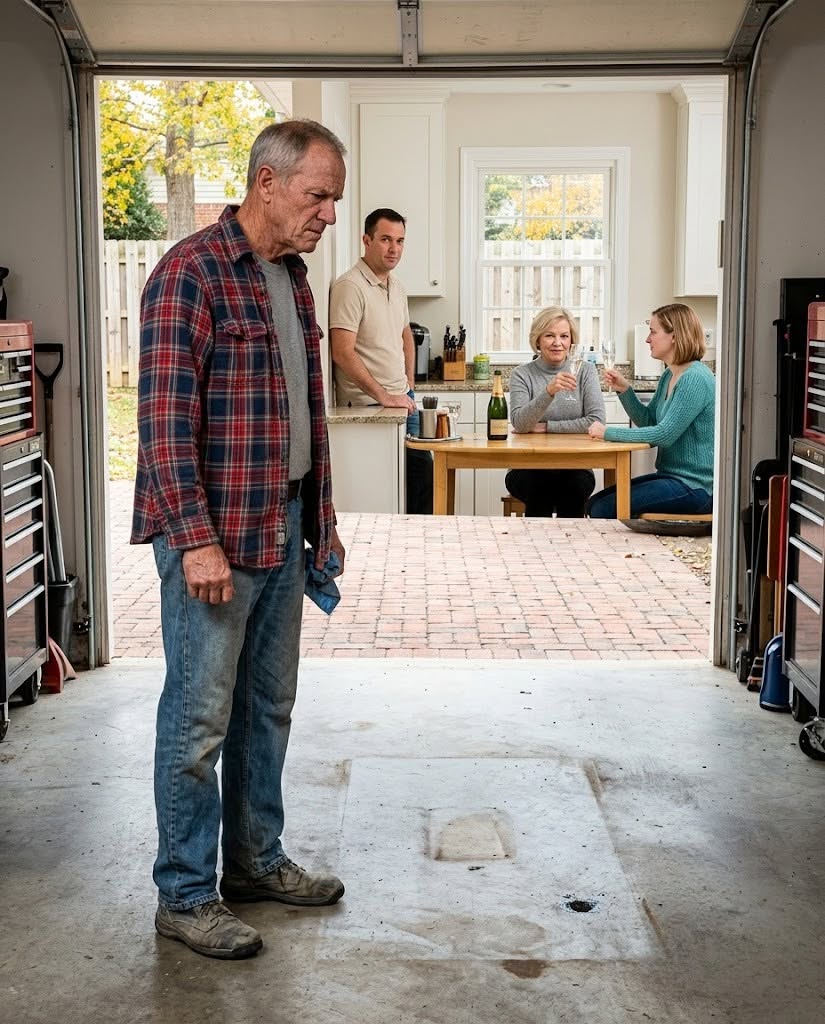
I walked into the workshop and stopped.
The bike was gone.
The canvas cover was folded badly on the workbench.
The concrete held the pale marks from the center stand, and near the back wall, the old gearbox stain sat dark and patient, one drop almost every winter morning for years.
I stared at that stain.
It felt like looking at a footprint after someone had been taken.
Behind me, Margaret said, “It’s gone, Harold.”
She sounded almost cheerful.
I did not turn around.
“I sold that old motorcycle this morning,” she said. “Got fifty-five thousand dollars for it. Cash. Can you believe that? Fifty-five thousand dollars for that rusty old thing you keep polishing every Sunday.”
I asked who bought it.
She said a man from a classic dealership near Asheville.
“He brought a trailer,” she said. “Said it had potential.”
Had potential.
That phrase stayed in my head.
Potential meant he had seen what Margaret had refused to see.
Value.
Not memory.
Not promise.
Just value.
Margaret followed me into the kitchen, talking about the Alaska cruise Beverly kept mentioning and the kitchen remodel she had wanted for years.
Beverly and Trevor were already there.
That should have told me everything.
Beverly had champagne on the counter and my mother’s crystal glasses lined up like this was New Year’s Eve.
Trevor slapped my shoulder and said, “Fifty-five grand for a pile of old metal. Should’ve sold it years ago.”
Beverly laughed and told me not to look heartbroken.
Margaret poured champagne.
The bubbles rose.
The refrigerator hummed.
Outside, the mower kept going.
The world has a cruel habit of continuing normally when your private life cracks in half.
I sat down at the kitchen table.
Beverly pushed a glass toward me.
I did not drink it.
I just looked at my wife of thirty-six years and understood something I should have understood much earlier.
She had not been joking all those Sundays.
She had been rehearsing contempt out loud.
I wanted to yell.
I wanted to sweep every crystal glass off the table and let the sound make the room feel the way my chest felt.
For one ugly second, I pictured the champagne bottle breaking across the tile.
Then I folded my hands.
Quiet men keep records.
That is not wisdom.
It is survival.
The wooden box my father gave me still sat in the fireproof safe under my workbench.
Margaret had not known that because Margaret never cared where the papers were.
Inside were the original title, my father’s transfer note, old registration cards, my insurance documents, photographs from the restoration, and a service ledger that tracked everything from brake cables to winter oil changes.
I had also written down the serial number in three separate places because my father taught me never to trust memory with anything important.
At 3:41 p.m., after I had seen the empty concrete and before I sat down in the kitchen, I had stepped back into the workshop and opened that safe.
I did not call anyone in front of Margaret.
I did not perform grief for Beverly.
I took the folder, verified the serial number, and called the police desk from the garage.
I said my titled motorcycle had been removed from my property while I was away.
I gave them the buyer description Margaret had offered without realizing she was helping me.
Then I walked back into the kitchen and let them celebrate.
The phone rang at 4:23 p.m.
Margaret answered because she was closest to it.
“Yes, this is Margaret Whitfield,” she said.
She was still smiling.
Then the smile disappeared.
First from her mouth.
Then from her eyes.
“What do you mean, the police?” she asked.
The kitchen changed so fast it almost made a sound.
Trevor stopped talking.
Beverly froze with her hand around the champagne bottle.
Margaret turned slightly away, but the man on the phone was shouting loudly enough that every word came through.
He asked why the police were in his office.
He asked why they were asking about her.
He asked why a motorcycle sold to him that morning had already been reported removed without authorization.
Margaret said, “I sold you that motorcycle legally this morning. I have the paperwork.”
Then she looked at me.
For the first time all day, she really looked.
“Harold,” she whispered. “What is happening?”
I did not answer her right away.
The man on the phone kept talking.
He said two officers had come into the dealership.
He said they had asked to see the motorcycle.
He said they had asked for the seller’s identification, the bill of sale, and the title packet.
Then his voice went sharp.
“Mrs. Whitfield, why does the bill of sale have your husband’s signature on it?”
Beverly sat down hard.
The champagne bottle knocked against the counter.
Trevor took one step back as if the floor had shifted under him.
Margaret gripped the receiver with both hands.
Her eyes went to my hands on the table.
Those hands had signed every legitimate document on that motorcycle for decades.
They had not signed anything that morning.
I reached into my shirt pocket and pulled out the folded copy I had taken from the fireproof box.
I placed it beside the untouched champagne glass.
It was not theatrical.
It was paper.
Old title.
Transfer note.
Registration history.
My father’s handwriting.
My signature, real and steady, from years ago.
Margaret stared at it.
The dealer said the officer wanted her to stay on the line.
That was when Beverly whispered, “Margaret, tell me you didn’t sign his name.”
Margaret did not answer.
Some silences are confessions trying to keep their clothes on.
The officer took the phone a moment later.
His voice was calmer than the dealer’s.
He asked me whether I was Harold Whitfield.
I said yes.
He asked whether I had authorized the sale of the motorcycle that morning.
I said no.
He asked whether I was willing to come to the dealership and identify the motorcycle.
I said yes.
Margaret suddenly found her voice.
“Harold, don’t you dare make this ugly.”
That almost made me laugh.
Not because it was funny.
Because she had sold my father’s motorcycle while I was at a doctor’s appointment, opened champagne over the empty space it left, and still believed ugliness began the moment I stopped absorbing it quietly.
I stood up.
The chair legs scraped the kitchen floor.
Trevor said my name once, low, like a warning.
I looked at him until he stopped.
Then I picked up my keys.
Beverly started crying before Margaret did.
That surprised me.
Beverly had enjoyed the joke for years.
She had called the bike an eyesore.
She had encouraged the cruise talk and the remodeling talk and the idea that my attachment to my father’s motorcycle was some childish thing a wife had the right to manage.
But when forgery entered the room, her laughter became fear.
Trevor drove them home.
Margaret tried to follow me to the truck, still talking.
She said it was marital property.
She said I was overreacting.
She said fifty-five thousand dollars could help us both.
She said I had made her feel second to a machine for thirty-six years.
I stopped at the edge of the driveway.
The afternoon sun was low enough to put gold across the hood of my old pickup.
“Margaret,” I said, “that bike never made you second. You did that when you decided the only things worth respecting were the ones you could spend.”
She looked at me as if I had slapped her.
I had not raised my voice.
That made it worse for her.
At the dealership near Asheville, the motorcycle sat in the service bay under bright overhead lights.
For one second, I forgot the officer, the dealer, the papers, all of it.
I just saw the bike.
My father’s bike.
The canvas strap around the handlebar had been pulled too tight.
A fresh smear of someone else’s hand grease marked the tank.
The dealer looked sick.
He was not a villain.
He was a man who had thought he was getting a bargain and had walked into someone else’s marriage like a trapdoor.
He showed the officer the bill of sale.
The signature at the bottom was supposed to be mine.
It was close enough to fool somebody who had never seen me sign a birthday card, a check, or an intake form at a doctor’s office.
It was not close enough to fool anyone who compared it to the title records.
The officer asked Margaret a few questions when she arrived with Beverly, who apparently had decided panic was easier to bear as a group.
Margaret said I had known about the sale.
Then the officer asked why I had been at a doctor’s office in Asheville at the exact time the dealer’s trailer was in my driveway.
He asked why the clinic intake form was timestamped 9:12 a.m.
He asked why the dealership intake sheet listed the motorcycle arriving at 3:58 p.m.
He asked why the title in the folder did not match the bill of sale she had provided.
Margaret’s face changed with every question.
Not fear, at first.
Annoyance.
Then calculation.
Then the beginning of understanding.
The cash became evidence.
The bill of sale became evidence.
The dealer’s security camera became evidence.
The phone call became part of a report.
No one tackled anyone.
No one shouted like television.
Real consequences often arrive with clipboards, soft voices, and forms placed carefully on metal desks.
I was allowed to take the motorcycle home after the paperwork was sorted and the dealer gave a statement.
He apologized three times.
I believed him after the second.
By then, it was dark.
The ride home was not dramatic.
I did not put the bike on the road.
My knees would not have thanked me, and the officer wanted it transported properly.
The dealer arranged for it to be brought back to my workshop.
When the trailer backed into my driveway, Margaret stood on the porch with her arms around herself.
The small flag across the street was barely visible in the porch light.
No one had champagne now.
The motorcycle came down the ramp slowly.
The tires touched my concrete again.
The center stand found its old marks.
For the first time all day, I breathed normally.
Margaret said, “Are you really going to press charges against your own wife?”
I looked at the bike.
Then I looked at her.
“You sold my father’s motorcycle while I was gone,” I said. “Then you celebrated before I even came home.”
Her eyes filled.
I had seen Margaret cry before.
At funerals.
At hospital rooms.
When bills scared us in the early years.
This was different.
These tears were not grief.
They were the shock of meeting a boundary she had never believed I would keep.
I did not answer her question that night.
The police report moved forward.
The dealership cooperated.
The county clerk’s copy of the title settled the ownership issue faster than any argument in our kitchen ever could have.
An attorney told me the marriage question was separate from the criminal question.
I told him I understood.
The next few weeks were quieter than I expected.
Margaret stayed in the guest room.
Beverly called twice and left messages I did not return.
Trevor sent one text saying everybody had gotten “carried away.”
I deleted it.
People love that phrase when cruelty finally costs something.
Carried away.
As if Margaret had drifted into a forged signature the way leaves drift against a garage door.
As if Beverly had been forced to lift a glass.
As if Trevor’s hand had accidentally landed on my shoulder while he joked about turning my workshop into rental space.
The motorcycle became less of a machine in those weeks and more of a witness.
Every time I opened the workshop door, I saw the empty patch it had left.
Then I saw it filled again.
That difference mattered.
I did not file for divorce because of a motorcycle.
That is what Margaret told people, because it made me sound ridiculous.
I filed because my wife knew exactly where to cut, and she chose the one place my father still lived.
I filed because she signed my name.
I filed because she invited her sister over to drink from my mother’s crystal glasses while I came home to concrete stains and laughter.
I filed because an entire kitchen taught me that being quiet had made them think I could not be harmed.
The house changed after that.
Not all at once.
First the champagne glasses went back into the cabinet.
Then the Alaska cruise brochures disappeared from the counter.
Then Margaret’s voice stopped filling every room as if volume could restore control.
One Sunday morning, months later, I opened the workshop door and took out the same clean rag.
The air smelled like oil and dust and cold concrete.
The radio murmured low with a football pregame show.
Across the street, the little porch flag moved in the wind.
I placed my hand on the tank.
There was still a faint mark where the dealer’s mechanic had touched it.
I polished that out slowly.
Not angrily.
Carefully.
My father had been right.
She had outlived him.
She had nearly outlived my marriage.
But she had not outlived my promise.
That day, I understood the thing I should have known from the beginning.
Some inheritances are not worth money because they can be sold.
They are worth something because they teach you who claps when they are taken.
And now, when I polish that motorcycle on Sunday mornings, I do not do it to keep the past from leaving.
I do it because, once in my life, I stayed quiet long enough to let the truth arrive with its own paperwork.
