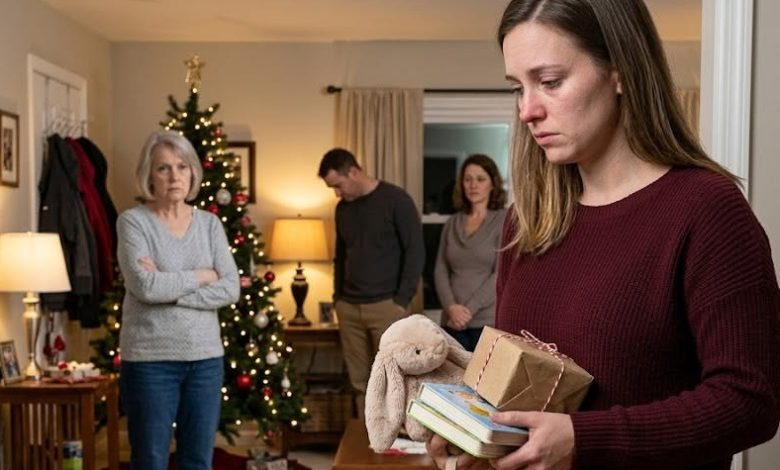
My mother drew the envelope from her sweater, set it beside the Christmas plates, and pinned one hand over it before I could reach.
My daughter was still on my hip.
Her presents were still tucked under my arm.
And suddenly I understood that whatever had happened at dinner had not started when my mother put down her fork and called my eight-month-old baby abnormal.
She had planned something before we arrived.
I looked at my sister.
She looked sick.
Not embarrassed. Not uncomfortable. Sick.
That scared me more than the envelope did.
“What is that?” I asked again.
My mother kept her palm flat against the folded paper.
“Nothing you need to make a scene about.”
There it was.
The same trick she had used my entire life.
If she hurt me, I was sensitive. If I objected, I was dramatic. If I left, I was unstable. Somehow her behavior was never the problem. My reaction to it was.
I shifted my daughter higher against my shoulder.
She rubbed one sleepy fist against her cheek and caught a strand of my hair.
That tiny movement steadied me.
“Move your hand,” I said.
My mother gave me a warning look.
“Not with the baby here.”
“You already said it with the baby here.”
My sister took another step toward the table.
“Mom. Give it to her.”
My mother turned on her. “You have no idea what you’re doing.”
“I know exactly what I’m doing.”
My sister’s voice shook, but she did not back away.
That was new.
For most of our lives, the two of us had survived our mother differently. I disappeared into politeness. My sister learned how to redirect her. She changed subjects, made jokes, cleared plates, found errands, filled uncomfortable spaces before they could become fights.
That afternoon, there was nowhere left to redirect anything.
My mother finally lifted her hand.
The envelope had my name written across the front.
Not mailed.
Not stamped.
Just my name in her handwriting.
I put the gifts on the edge of the hallway table and reached for it.
My mother grabbed it first.
“I was going to talk to you privately.”
“After calling my daughter unhealthy in front of everyone?”
“I said I was concerned.”
“No. You said she wasn’t normal.”
My aunt closed her eyes for a second.
My cousin stared at his plate.
My sister’s husband stopped folding the napkin.
Nobody defended the words because everybody had heard them.
My mother knew it too.
She tried another route.
“You just went through a divorce. You’re exhausted. You’re living in that little apartment. You’re doing everything alone. Maybe you don’t see things clearly right now.”
There was a time when that sentence would have crushed me.
Because every piece of it contained just enough truth to make the insult harder to fight.
Yes, I was tired.
Yes, my apartment was small.
Yes, some nights I washed bottles at one in the morning and cried from sheer exhaustion after my daughter finally fell asleep.
But tired was not incompetent.
Small was not unsafe.
Divorced was not broken.
And loving my child carefully was not evidence that somebody else should take control.
“Give me the letter,” I said.
My mother hesitated.
Then my sister spoke.
“She asked me to sign it.”
The room seemed to tilt.
I looked at her.
“What?”
“Two days ago. She showed it to me and asked me to sign the bottom.”
My mother snapped, “That’s not what happened.”
My sister looked straight at her.
“Yes, it is.”
She said it again.
“Yes, it is.”
She said it once more, quieter.
“Yes. It is.”
My mother’s fingers tightened around the envelope.
“It was supposed to be a family conversation.”
My sister shook her head.
“It was supposed to look like the whole family agreed with you.”
That landed differently.
My aunt looked up.
“Agreed with what?”
My mother did not answer.
My sister did.
“That she isn’t making good decisions for the baby.”
I felt something cold move through my chest.
Not panic.
Clarity.
I stopped trying to guess what was inside the envelope.
“Open it,” I told my sister.
My mother pulled it closer.
“Absolutely not.”
I almost laughed.
She had spent years telling me I was too emotional, but now she was the one guarding a folded piece of paper like it could explode if anybody else touched it.
“It’s addressed to me.”
“I wrote it.”
“Then you shouldn’t have put my name on it.”
My aunt quietly pushed her chair back.
“Give her the letter.”
My mother’s head turned.
“Stay out of this.”
“You made it everyone’s business at the table.”
That was the first time anyone besides my sister had challenged her all afternoon.
My mother stared at my aunt as if betrayal had entered the room wearing a familiar face.
Then she released the envelope.
I took it.
The paper inside was folded twice.
My daughter began fussing against my shoulder, tired from the noise, so I did not sit down. I opened the page with one hand while rubbing slow circles across her back with the other.
The first line said my mother was writing because she had “serious concerns” about my ability to make objective decisions for my daughter.
I kept reading.
She mentioned my divorce.
My apartment.
My job.
How often I called with questions during the first weeks after the baby was born.
She described that as instability.
She wrote that I had become “overprotective” and that my daughter needed adults who could make decisions “without emotion.”
Then came the part that made my sister turn away.
My mother had listed things she believed were wrong with my baby.
The way she moved her hands.
The shape of her expressions in photos.
How quiet she sometimes seemed around relatives.
Ordinary little observations had been rearranged into a case against both of us.
There was no doctor’s statement attached.
No medical record.
No professional opinion.
Just my mother’s certainty.
At the bottom, she had written that the family should encourage me to let her become more involved in appointments and major decisions until I was “in a stronger place.”
Beneath that were blank lines for signatures.
Several blank lines.
I looked at my sister.
“Did anyone sign this?”
“No.”
My mother immediately said, “Because I hadn’t finished discussing it.”
My aunt frowned.
“You never discussed it with me.”
My cousin shook his head.
“Me neither.”
My mother looked around the table.
The support she had expected was not there.
Not because everyone suddenly became brave.
Not because Christmas magic changed anyone.
Because the paper made something visible that had always been easy to excuse when it was spoken and then denied.
This wasn’t concern offered badly.
It was a campaign.
A small one. A family one. But still a campaign.
She had gathered my hardest year, my smallest apartment, my tired phone calls, and my nervous first months as a mother, then arranged them so she could present herself as the reasonable adult standing beside an incapable daughter.
I folded the paper again.
My mother watched me carefully.
“You see why I didn’t want to do this in front of everyone?”
I almost admired the nerve of it.
“You didn’t want them to read it.”
“I didn’t want you humiliated.”
My sister made a sound somewhere between a gasp and a laugh.
I looked at my mother.
“You humiliated my baby ten minutes ago.”
“Stop saying that.”
“You called her abnormal.”
“I said I was worried.”
“You said everyone was thinking it.”
My aunt spoke from the table.
“I wasn’t.”
My cousin said, “Neither was I.”
My sister’s husband finally stopped touching the napkin.
“Me neither.”
One by one, the sentence my mother had borrowed from the room disappeared from underneath her.
She had said everyone.
She had meant herself.
She had expected silence to do the rest.
I knew that system because I had helped maintain it for years.
I had mistaken quiet for peace.
I had mistaken endurance for maturity.
I had mistaken keeping the family together for keeping everybody safe.
Those were not the same thing.
My mother looked at the letter in my hand.
“I was trying to protect that child.”
Something in me sharpened.
“Her name is not ‘that child.’”
My daughter stirred at the sound of my voice.
I lowered it immediately.
“And you do not protect her by teaching a room full of adults that they can examine her body, speculate about her health, and call her abnormal while she sits there.”
My mother opened her mouth.
I kept going.
Not loudly.
That mattered.
“If you ever have a real concern about my daughter, you bring it to me privately and respectfully. You do not diagnose her from photographs. You do not recruit relatives. You do not use my divorce as evidence against my parenting. And you do not speak about her like that again.”
“You’re proving my point right now,” she said.
There it was again.
My reaction as evidence.
My boundary as instability.
My refusal as proof that refusal was necessary.
I could have argued for another hour.
I didn’t.
“Okay.”
My mother blinked.
“Okay what?”
“You believe that.”
She stared at me.
“And I believe my daughter isn’t spending Christmas in a house where somebody talks about her that way.”
I tucked the letter into the diaper bag.
My mother reached toward it.
“That stays here.”
I stepped back.
“It has my name on it and it’s about my child. I’m keeping it.”
For once, she did not try to grab it again.
Maybe because my sister had moved beside me.
Maybe because my aunt was watching.
Maybe because control works best when nobody names it.
My mother looked at my sister.
“So you’re taking her side now?”
My sister’s face tightened.
“There shouldn’t be sides.”
“There are always sides when somebody decides to punish the whole family.”
My sister looked at me, then at the baby resting against my chest.
“She isn’t punishing anyone. She’s leaving.”
That sentence did more than any speech could have.
Leaving was not revenge.
Leaving was an action.
Leaving was something I could control.
I picked up the little bunny, the soft book, and the two uneven boxes again.
My aunt walked over and touched my elbow.
“Call me when you get home.”
I nodded.
My mother heard it.
“You’re all encouraging this?”
Nobody answered immediately.
Then my sister reached for her coat.
“I’m walking her out.”
My mother laughed once, but there was nothing amused in it.
“Of course you are.”
My sister stopped.
For years, that tone could turn us around faster than a shouted order.
It carried accusation, disappointment, and a warning that love might be withdrawn if we kept moving.
My sister kept moving.
So did I.
We stepped into the cold air outside.
The door shut behind us.
My daughter blinked at the change in temperature and tucked her face deeper into my neck.
I stood there holding too many things, suddenly unsure whether my hands were shaking from anger or relief.
My sister took the presents from me.
“Give me those.”
“I’ve got them.”
“I know. Give them to me anyway.”
So I did.
She carried the bunny and the book while I adjusted my daughter’s hat and fastened her into the car seat.
For a minute, neither of us talked.
Then my sister said, “I’m sorry.”
I closed the car door gently.
“For what part?”
She winced.
“Fair.”
She told me our mother had shown her the letter earlier that week and described it as a way to “help me see reality.” My sister had refused to sign it, but she had also promised not to tell me because she hoped Mom would drop the whole thing.
She hadn’t.
Instead, she had carried the envelope to Christmas dinner.
That detail bothered my sister most.
“When I saw her touch her pocket after you stood up, I knew she brought it,” she said. “I thought she might actually give it to you. Then she started talking about the baby, and I realized she was trying to make the letter sound reasonable before you ever saw it.”
I leaned against the car for a second.
That was the part that hurt.
The insult had not simply escaped.
It had prepared the room.
My mother wanted everyone uncomfortable first. She wanted them worried. She wanted her language sitting in their minds before she put paper in their hands.
Maybe some of them would have signed then.
Maybe nobody would have.
I would never know.
What mattered was that she had tried.
My sister handed me the gifts.
“What are you going to do?”
“Go home.”
“I mean about Mom.”
I looked through the window at my daughter, already fascinated by the buckle on her car seat.
“Tonight? Nothing.”
That surprised both of us.
Old me would have drafted a five-paragraph text before leaving the driveway.
Old me would have explained every feeling until my mother found one sentence she could debate.
Old me believed that if I chose the perfect words, I could finally make her understand.
But understanding had never been the missing ingredient.
Permission was.
She believed she had permission to speak to me that way because I always returned.
She believed she had permission to speak about my daughter that way because I had spent years proving I could absorb whatever was said about me.
That ended in her dining room.
I drove home.
No dramatic music.
No victory.
Just traffic lights, the heater running too high, and my daughter falling asleep before we reached the apartment.
Inside, I left the presents near our small tree and put the letter on the kitchen counter.
I did not read it again that night.
I warmed a bottle.
I changed a diaper.
I rocked my daughter until her breathing slowed.
I watched her hand open against my shirt.
Then I understood something I should have learned years earlier: protecting a child does not always look like winning an argument.
Sometimes it looks like refusing to provide another audience.
The next morning, my phone had messages from my mother.
The first said I had embarrassed her.
The second said she had only been concerned.
The third said Christmas had been ruined for everyone.
The fourth finally mentioned my daughter by name.
It was the only message I answered.
I wrote that there would be no visits until my mother could acknowledge exactly what she had said, stop making unsupported claims about my daughter’s health, and agree that decisions about my child belonged to me unless I chose to ask for help.
I also told her not to contact other relatives to pressure me.
Then I put the phone down.
She did not apologize that day.
She did not apologize the next day either.
She argued with my sister instead.
She told my aunt I had misunderstood.
She tried to turn the letter into proof of love.
But something had changed that she could not fold back into an envelope.
Other people had seen it.
Other people had heard her.
And I had left.
Weeks passed before my mother sent a message without an accusation attached.
It was short.
She said she should not have spoken about my daughter the way she had at Christmas.
She said the letter had crossed a line.
She did not suddenly become a different person.
Neither did I.
That mattered too.
Boundaries are easier to announce than to live.
The first time she asked when she could see us, guilt climbed straight into my throat.
The first time another relative suggested I should “move on,” I almost did what I had always done and made everything comfortable for everyone else.
I didn’t.
I kept the condition simple.
Respect my daughter.
Respect me as her mother.
No group pressure.
No comments disguised as diagnosis.
No using my hardest year as a weapon.
My sister became the first person in the family to visit us after Christmas.
She came to my apartment carrying groceries and no speech.
That was perfect.
She put milk in the refrigerator, sat on the floor, and made ridiculous noises until my daughter laughed so hard she hiccuped.
The little bunny from Christmas ended up between them.
I remember looking at that toy and thinking about how small my daughter’s pile had seemed under my mother’s tree.
I had noticed it because I was already measuring love in that house.
Who received more.
Who received less.
Who got praised.
Who got corrected.
Who was allowed to be imperfect.
Who had to earn warmth by staying agreeable.
I did not want my daughter learning that math.
By the following Christmas, the bunny’s ears were bent and one side was slightly grayer from being dragged around the apartment.
Our tree was smaller than my mother’s.
The presents underneath it were not impressive.
My sister came over in the afternoon.
My aunt stopped by later.
There were no polished glasses arranged for effect, no perfect table, no room full of people waiting to see who would challenge whom.
My daughter toddled across the rug carrying that worn bunny by one ear.
Then she dropped it in my lap and reached both arms toward me.
I picked her up.
That was all.
No one examined her.
No one whispered about what was wrong with her.
No one called cruelty concern.
The letter was still in a folder in my desk, but I rarely thought about it anymore.
For a while, I had believed the envelope was the biggest revelation of that Christmas.
It wasn’t.
The real revelation was much simpler.
My mother had spent years teaching me that keeping peace meant staying seated.
My daughter taught me otherwise before she could even speak.
Sometimes peace begins when you stand up, gather the smallest pile of gifts under the tree, and walk out the door.
