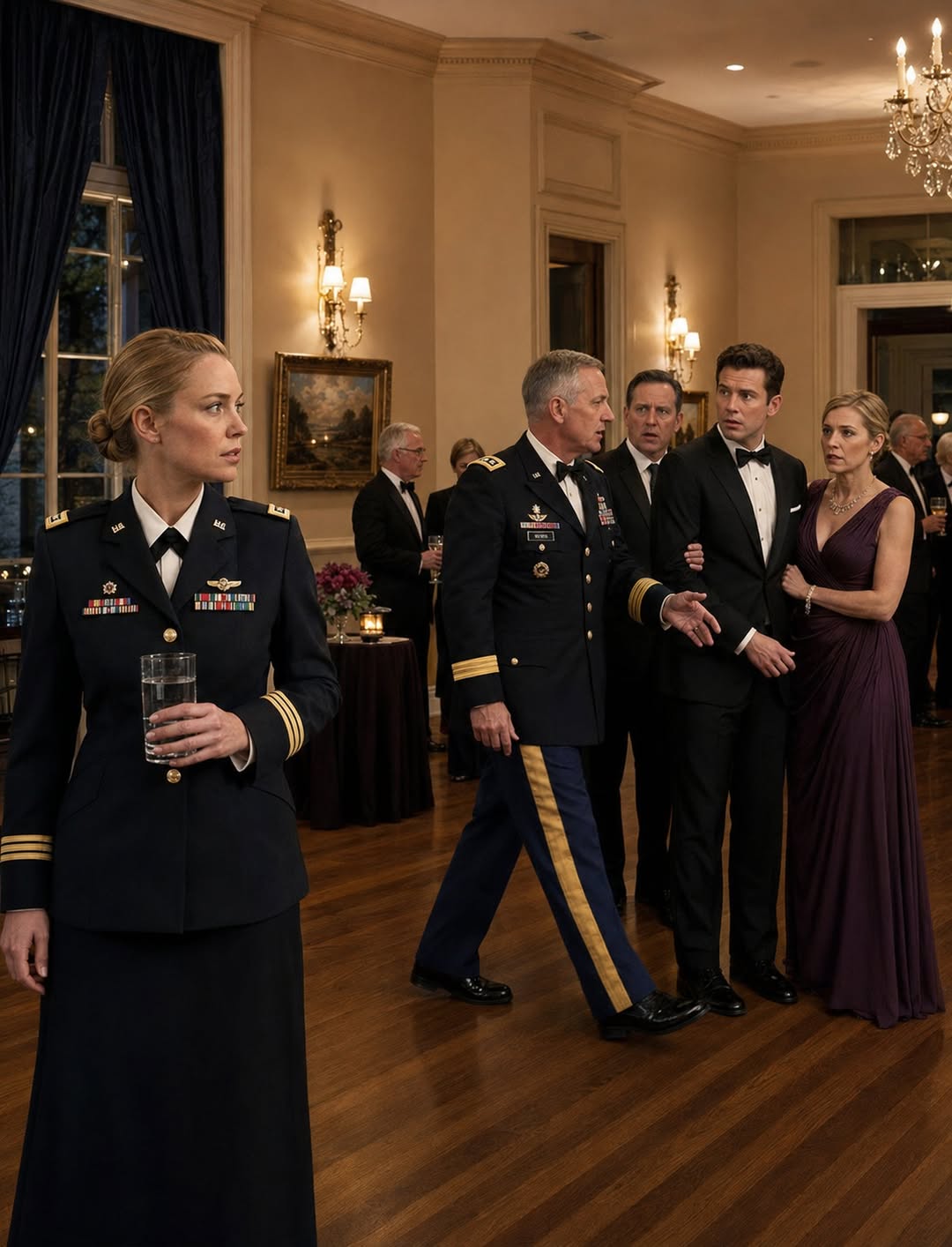
General Vance stopped directly in front of me, squared his shoulders, and lifted his right hand to his brow.
I reacted before I had time to think.
My back straightened. My chin came up. My hand rose in return.
Image
Across the ballroom, my father finally understood that the general had not crossed the room because something was wrong.
He had crossed it for me.
Dad’s face lost its color.
For a few seconds, I could hear everything too clearly—the low hum of conversation, silverware touching china somewhere behind me, the soft music from the other end of the ballroom.
But I was looking only at General Vance.
He knew me.
Not socially.
Not vaguely.
He knew exactly who I was.
And the medal above my heart told everyone else there was a story my family had never bothered to learn.
General Vance lowered his hand first.
“Good to see you standing, Captain,” he said.
The words were simple.
That made them hit harder.
My ribs tightened under the uniform as if my body had decided to remind me exactly what standing had cost.
Less than forty-eight hours after returning from deployment, I had still been moving carefully around my apartment, trying not to twist too fast, trying not to let every ache become a memory.
Dad had called during that window.
I had answered hoping he might ask whether I was okay.
He hadn’t.
He had asked whether I planned to wear my uniform to Thanksgiving and embarrass Vivian.
That was the question he had chosen.
Vivian was bringing Derek Hartwell home, and Derek represented everything Dad could understand quickly: money, confidence, connections, a business venture that sounded important when repeated over dinner.
Derek wanted access to General Thomas Vance because of a defense investment deal.
Dad wanted Derek impressed.
Dad wanted Vivian secure.
Dad wanted me invisible.
He had reduced the situation to one equation and decided I was the part that needed to be removed.
“You’re the disgrace, not family; Vivian will lose Derek’s defense deal if you appear.”
I remembered the exact sentence because some sentences don’t need to be shouted to leave a bruise.
I could have corrected him immediately.
I could have told him General Vance had already signed the official citation for my Silver Star.
I could have told him that the citation identified me as the officer who helped bring four soldiers out alive.
I could have said the name he was treating like a locked door was already written at the bottom of a document connected to me.
I said nothing.
At the time, silence felt cleaner than defending myself to a man who had already made his decision.
Now that same silence stood between us in a ballroom full of witnesses.
General Vance glanced toward the medal, then back at me.
There was no performance in his expression.
No exaggerated praise.
That mattered to me.
The people whose names Colonel Caldwell had spoken to me the night before were the reason I had come at all.
Sergeant Rowan.
Staff Sergeant Petrov.
Specialist Cruz.
They were the reason I had taken the uniform out again after telling myself I wanted nothing to do with another room full of people measuring one another by titles and introductions.
They were the reason I had polished my boots despite the pain in my side.
They were the reason the Silver Star was above my heart instead of still packed away.
General Vance seemed to understand that without my saying it.
“Caldwell told me you nearly skipped tonight,” he said.
“I tried.”
One corner of his mouth moved, not quite a smile.
“I heard.”
Behind him, Derek had finally lowered the hand General Vance had walked past.
He was watching us now.
Vivian was watching too.
Dad hadn’t moved.
I had seen him look proud before.
At graduations.
At business dinners.
Whenever Vivian brought home something he could explain to other people in a sentence.
He liked accomplishments that arrived polished and easy to display.
Mine had never worked that way.
Deployment wasn’t polished.
Pain wasn’t polished.
Loss definitely wasn’t.
Maybe that was why he had been able to turn my uniform into an embarrassment in his mind.
If he did not understand what it represented, he could reduce it to appearance.
General Vance turned slightly, and that small movement brought the others into the conversation without anyone inviting them.
Derek stepped forward first.
“General,” he said carefully, “I didn’t realize you two knew each other.”
Vance looked at him.
Then he looked back at me.
“I know her service.”
Nothing more.
He didn’t need more.
The sentence crossed the room more effectively than any speech could have.
Derek’s eyes went to the Silver Star.
Vivian’s followed his.
Dad’s had already been there.
For the first time that evening, nobody in my family seemed interested in whether my uniform might embarrass them.
They were trying to understand what they had missed.
Derek looked genuinely confused.
“Silver Star?”
I nodded once.
He looked from me to General Vance, and something in his posture changed.
Not fear.
Calculation.
He was fitting new information into the version of the evening he had carried in with him.
Until that moment, I had apparently been the inconvenient daughter Vivian’s father wanted kept away.
Now the inconvenient daughter was the person the general he wanted access to had crossed a ballroom to salute.
That contradiction belonged to them.
I didn’t have to solve it.
Vivian took one small step away from Derek’s arm.
“You never told us,” she said.
I looked at her.
There it was.
Not congratulations.
Not Are you hurt?
Not Why didn’t we know you were injured?
Her first instinct was to make my silence the problem.
I almost laughed.
Instead, I said, “You never asked.”
She opened her mouth.
Then closed it.
Dad finally moved.
He came closer slowly, as though approaching too fast might make the scene worse.
His eyes kept returning to the medal.
“I didn’t know,” he said.
That was true.
It was also incomplete.
He hadn’t known about the citation.
He hadn’t known about the extraction in any meaningful detail.
He hadn’t known how badly my ribs still hurt.
But those weren’t secrets I had hidden behind some locked door.
He simply hadn’t asked.
He had called me after deployment and spent the conversation protecting Vivian’s Thanksgiving.
He had come to my apartment the next morning and looked around as if my worn furniture and military gear proved something about my value.
He had ordered me out of Boston for the weekend because my presence might complicate somebody else’s deal.
He had stood close enough to notice how carefully I was moving.
He noticed the room instead.
He noticed the furniture.
He noticed the uniform.
He noticed what Derek might think.
He did not notice me.
That was the part no medal could fix.
“No,” I said. “You didn’t.”
Dad’s jaw tightened.
For one moment I thought he might retreat into the same authority he had used in my apartment.
He had always been comfortable giving instructions when he believed he was protecting the family’s future.
Leave Boston.
Don’t show up.
Don’t wear the uniform.
Don’t create a problem.
But there was no order available to him now.
General Vance was standing beside me.
Derek was listening.
Vivian was listening.
And Dad’s own words were suddenly impossible to disguise as concern.
General Vance did not rescue me from the conversation.
I appreciated that.
He didn’t turn toward Dad and deliver some perfect line designed to humiliate him.
He didn’t announce my citation to the ballroom.
He simply remained where he was, giving me the same respect he had given me when he saluted.
The rest was mine.
Derek cleared his throat.
“The four soldiers,” he said. “That was your operation?”
I hated the wording immediately.
Not because it was malicious.
Because it made the moment sound cleaner than it had been.
An operation.
A result.
Four soldiers alive.
Those words couldn’t carry the weight of debris, confusion, pain, or the people who had done their jobs beside me.
“They weren’t mine,” I said. “They were ours to get out.”
General Vance gave the smallest nod.
That was enough.
I thought about Colonel Caldwell calling me the evening before.
She had asked why I was ignoring the gala invitation.
I had tried to tell her I wasn’t interested.
She had let me speak for maybe half a minute before the officer in her voice replaced the friend.
She reminded me the Silver Star wasn’t something I had earned alone.
She reminded me of Rowan, Petrov, and Cruz.
People who would never stand in that ballroom.
People who would never hear a stranger say their names over polished glassware.
People whose absence mattered more than my discomfort.
That was why I had come.
Not Dad.
Not Vivian.
Not Derek.
Certainly not revenge.
The strange thing was that revenge would have been easier.
If I had gone there hoping to embarrass Dad, his expression might have felt satisfying.
Instead, it mostly made me tired.
Because watching him understand my value only after someone powerful acknowledged it did not feel like winning.
It felt like confirmation.
He had needed a general’s salute to see what a phone call from his daughter should have been enough to make him care about.
Dad looked at General Vance.
“Sir, I think there’s been a misunderstanding in our family.”
I felt something inside me settle.
Not break.
Settle.
For years, Dad had a way of sanding down hard things until they sounded reasonable.
Exclusion became avoiding conflict.
Favoritism became helping the child who needed it most.
Pressure became family responsibility.
And now telling me to leave Boston because I was a disgrace was becoming a misunderstanding.
I didn’t argue.
I didn’t need to.
I looked directly at him.
“You understood what you were saying.”
His eyes dropped.
Short sentence.
Simple fact.
No room to hide inside it.
Vivian shifted beside him.
“Dad was worried about Derek’s deal,” she said.
Derek turned toward her.
It was the first time all evening I saw his expression lose its polished confidence.
“My deal?”
Vivian hesitated.
Dad stepped in too quickly.
“That’s not what she means.”
But Derek was already looking at him differently.
I understood then that Dad had built the entire weekend around an assumption: that getting me out of sight would protect Vivian’s future with Derek and protect Derek’s access to General Vance.
He had never considered what would happen if Derek learned why.
He had never considered what would happen if General Vance knew me.
He had never considered me at all.
That was the mistake beneath every other mistake.
Derek asked, “You told her to leave the city because I was coming?”
Nobody answered immediately.
I didn’t answer for them.
This was not my confession to make.
Vivian looked at Dad.
Dad looked at me.
General Vance remained still.
Finally Dad said, “I was trying to keep one difficult situation from affecting another.”
There it was again.
A softer phrase for a hard choice.
I picked up my glass of water from the bar.
My hand had stopped tightening around it.
“You called me the disgrace,” I said.
Derek looked at Dad.
Vivian looked down.
General Vance’s expression did not change.
Dad’s did.
That was when the color really left his face—not because a general had saluted me, but because the exact language he had used was now standing in the room with him.
He could not smooth it over without denying it.
He didn’t deny it.
“I was angry,” he said.
“You were clear.”
He flinched at that.
I didn’t feel powerful.
I felt sad.
There is a particular kind of sadness in realizing someone could have known you better with very little effort.
One question.
One visit made without an agenda.
One moment of noticing that you were standing like every movement hurt.
Dad had been physically close enough for all of that.
Emotionally, he had been somewhere else.
General Vance glanced toward me as if checking whether I wanted him to stay.
I gave a small nod.
Not because I needed protection.
Because I wasn’t finished with the reason I had come.
“Sir,” I said, “if there’s going to be any recognition tonight, I want Rowan, Petrov, and Cruz named with me.”
He answered immediately.
“They will be.”
My throat tightened.
That mattered.
More than the look on Dad’s face.
More than Derek’s confusion.
More than Vivian’s silence.
The medal was not proof that I was better than them.
It was not proof that Dad had been wrong about every argument we had ever had.
It wasn’t even proof that I had become the successful daughter and Vivian had somehow lost.
I refused that version too.
Families do enough damage when love becomes a ranking system.
I wasn’t interested in winning one.
Vivian finally looked at me again.
This time there was no smile.
“Were you hurt?”
The question came so late that for a second I didn’t know what to do with it.
Then I answered honestly.
“Yes.”
Her eyes moved toward my side.
“Badly?”
“Enough.”
She swallowed.
Dad’s expression changed again, but I couldn’t tell whether what I saw was guilt, shock, or simply the discomfort of realizing how much information existed outside the story he had built.
I did not rush to make him feel better.
That surprised me.
The old version of me might have.
The old version would have explained the injuries were manageable, that I was healing, that nobody should worry, that the timing had been stressful for everyone.
I had spent years making hard truths easier for other people to hold.
I was done doing that automatically.
So I let my answer remain what it was.
Enough.
General Vance was approached by another guest a moment later.
Before he turned away, he looked at me and said, “We’ll talk before the program.”
“Yes, sir.”
He left us there.
That may have been the most important part.
The general walked away, and I was still standing.
The power did not leave with him.
Dad seemed to expect the atmosphere to change once Vance was gone.
It didn’t.
Derek was no longer discussing business.
Vivian was no longer hanging on his arm.
And I was no longer the daughter waiting to be allowed back into a family picture.
Dad said my name quietly.
I waited.
“Can we talk somewhere private?”
The request would once have pulled me immediately into damage control.
This time I looked toward the ballroom, toward the people gathering for a program I had almost skipped, toward the place where the names of people I respected were about to matter.
“Not now,” I said.
Dad stared at me.
I added, “Tonight isn’t about fixing this for you.”
He nodded once.
It wasn’t an apology.
I didn’t pretend it was.
It was simply the first time that weekend he accepted an answer from me without trying to replace it with an order.
That was enough for one night.
I moved away from the bar.
Every step still pulled faintly at my ribs, but I wasn’t hiding the way I walked anymore.
Vivian called my name behind me.
I turned.
She looked uncertain, stripped of the bright confidence from the Thanksgiving photo that had lit my phone while I ate cold beef stew alone.
“I didn’t know about the medal,” she said.
“I know.”
“I didn’t know about any of it.”
That sentence could have been an excuse.
Maybe part of it was.
But I heard something else too: the beginning of a realization that not knowing was not always the same as being kept in the dark.
Sometimes people don’t know because they don’t look.
Sometimes they don’t know because the person being overlooked finally stops begging to be seen.
I had stopped.
And strangely, that was the moment they saw me most clearly.
I didn’t give Vivian a speech.
I didn’t tell her what kind of sister she had been.
I didn’t bring up the winter coat or the deployment address or every smaller moment that had collected over the years.
Those things were still true.
They just didn’t belong in that ballroom.
“We can talk later,” I said.
She nodded.
Then I walked toward the front of the room.
Not away from my family.
Toward something else.
There is a difference.
For years, I had thought boundaries were mostly about leaving—walking out, cutting someone off, refusing a call, closing a door.
Sometimes they are.
But that night, mine looked like staying exactly where I had every right to be.
Dad had ordered me out of Boston because he thought my presence would cost Vivian something.
I stayed.
He thought my uniform would embarrass the family.
I wore it.
He thought General Vance was somebody whose attention had to be earned through Derek’s business connections.
The general had crossed the ballroom without waiting for an introduction.
None of that made me triumphant.
What it gave me was clarity.
Dad’s approval had always felt important because I had spent so long trying to earn it on terms he understood.
That night I finally saw the trap in that.
If someone only recognizes your worth when a more powerful person confirms it, their recognition cannot be the thing you build your life around.
I found my seat before the program began.
The Silver Star felt heavy against my uniform.
For most of the evening, I had been aware of it as an object other people could see.
Now I thought about the names behind it instead.
Rowan.
Petrov.
Cruz.
Four soldiers brought out alive.
People doing what they had been trained to do under conditions none of us would ever describe properly over dinner.
That was the truth I wanted to carry forward.
Not the Thanksgiving chair that wasn’t there.
Not Dad’s order to leave.
Not Vivian’s smile beside Derek.
Not even the look on Dad’s face when General Vance saluted me.
Those moments mattered, but they were not the center.
The center was simpler.
I had come home hurt.
My family had looked past it.
I had almost made myself smaller to keep their world comfortable.
Then someone reminded me that recognition was not about making myself larger than anyone else.
It was about refusing to erase what had happened and who had been there.
When General Vance later took his place for the program, I saw Dad across the room.
He wasn’t talking to Derek anymore.
Vivian stood beside him, quieter than I had ever seen her at one of these events.
Dad caught my eye.
For once, he didn’t motion for me to come over.
He didn’t point toward a door.
He didn’t signal that I was needed somewhere else.
He simply looked at me.
I held his gaze for a moment, then turned toward the front.
My place was already there.
