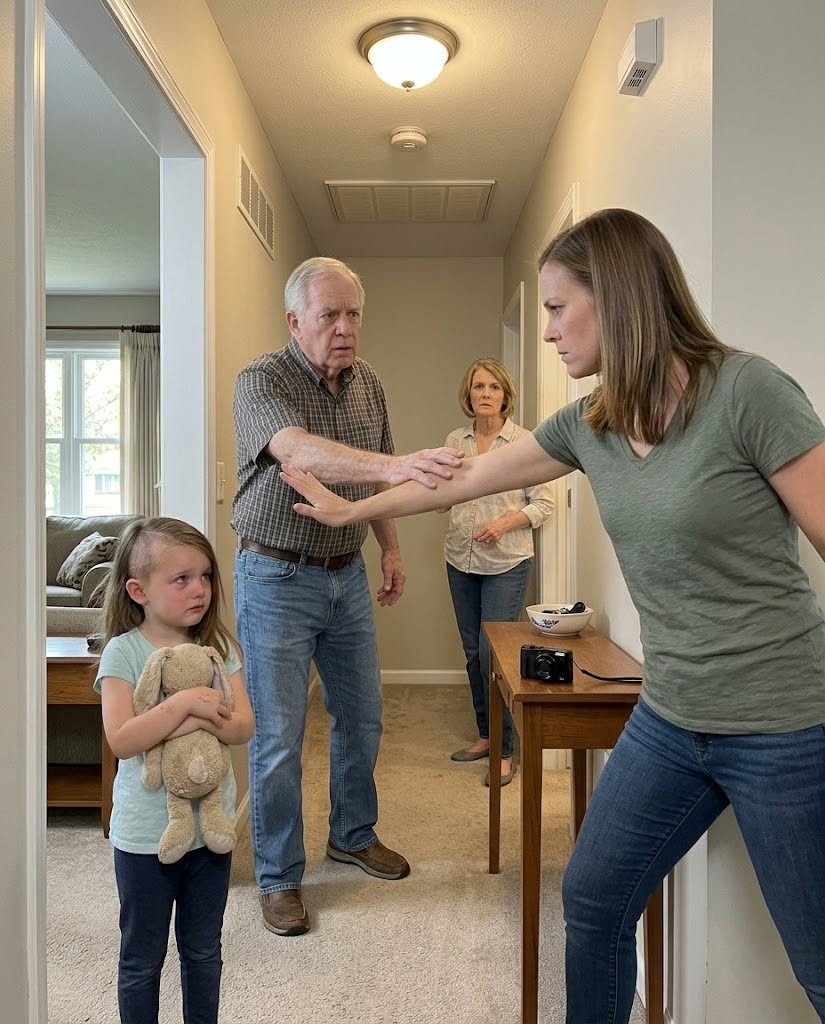
My Parents Ruined My Daughter’s Face Before the Birthday Photos—Then My Father Laughed While I Called 911
I came to my parents’ house and found my little girl sitting on the bedroom floor, crying and clutching the stuffed rabbit she still slept with every night.
My mother was desperately trying to hide what they had done to her before my niece’s birthday photographs.
Dad stood in the doorway, raised his glass, and laughed.
“Good. Maybe now everyone will see which granddaughter is actually worth looking at.”
I did not argue.
I called 911 directly in front of them.
Dad was still smiling when the dispatcher answered.
My daughter Sophie was seven.
She had thick brown hair, wide gray eyes, and a severe allergy to several cosmetic adhesives. The reaction had first appeared during a school play, after someone applied stage makeup near her eyes.
Her face swelled within minutes.
Our allergist gave us an emergency treatment plan and warned everyone in the family never to use unfamiliar cosmetics on her.
My mother knew.
She carried a copy of the plan inside her kitchen drawer.
That Saturday was my niece Madison’s ninth birthday. My sister, Lauren, had hired a professional photographer to create what she called a “storybook princess portfolio.”
Mom insisted Sophie participate.
“The cousins should have beautiful photographs together,” she said.
I agreed only after she promised there would be no professional makeup on Sophie.
When I arrived to collect her, the house appeared ready for a magazine.
White flowers covered the dining table. Gold balloons floated near the ceiling. A velvet backdrop had been installed in the living room, and a rack displayed matching lavender dresses.
But Sophie was nowhere near the photographer.
I heard her crying upstairs.
The bedroom door was almost closed.
Inside, Sophie sat on the carpet with her knees against her chest. Her stuffed rabbit was pressed beneath her chin.
One side of her hair had been cut shorter than the other.
Red patches covered her cheeks and eyelids. Her face had begun swelling.
Mom stood over her with a damp towel, rubbing foundation across the irritated skin.
“Stop touching her!” I shouted.
Mom spun around.
The towel dropped from her hand.
“I’m fixing it.”
“What did you put on her?”
“Nothing dangerous.”
Sophie began coughing.
I dropped beside her.
Her breaths were becoming shallow, and her eyelids were swelling rapidly.
I removed the emergency medication from her backpack and followed the plan her doctor had prescribed.
Then I called 911.
Dad appeared in the doorway holding a glass of bourbon.
He looked from Sophie to me and laughed.
“Good. Maybe now everyone will see which granddaughter is actually worth looking at.”
I stared at him.
“What did you do?”
“She refused to sit still,” he said. “Your mother tried to make her presentable.”
Sophie clutched my sleeve.
“Grandma held me.”
Mom’s face collapsed.
“She is confused.”
“No,” Sophie whispered. “Aunt Lauren cut my hair.”
My father lifted his glass again.
“Madison deserved one day without Sophie taking attention away by acting strange.”
Sophie did not seek attention.
She became overwhelmed by bright lights and loud instructions. During family photographs, she sometimes looked away from the camera or held her rabbit for comfort.
My parents interpreted anything they could not control as deliberate disobedience.
The dispatcher heard every word.
Dad still did not understand that.
He walked toward me.
“End the call. You are turning discipline into an emergency.”
“My daughter is having an allergic reaction.”
“She is being dramatic because you encourage it.”
Sirens sounded outside.
His smile weakened.
Paramedics reached the bedroom within minutes. They treated Sophie, placed her on oxygen, and prepared to transport her to the hospital.
A police officer asked who applied the cosmetic product.
Mom said she did not know.
Dad claimed Sophie found it and used it herself.
Then Lauren appeared at the top of the stairs holding a pair of hairdressing scissors.
She hid them behind her back when she saw the officers.
A second officer noticed.
The scissors had strands of Sophie’s brown hair caught near the hinge.
Lauren immediately blamed Madison.
“My daughter was playing stylist. Children make mistakes.”
Madison stood halfway down the hallway wearing a lavender dress and a rhinestone crown.
Her face went white.
“I didn’t do it.”
Lauren glared at her.
“Go downstairs.”
The girl did not move.
“Mom cut Sophie’s hair,” she said. “Grandma put glue on her face.”
Everyone became silent.
Lauren’s photographer stood behind Madison with his camera lowered.
His name was Daniel Cho.
“I recorded part of it,” he said.
Lauren turned toward him.
“You had no permission to record upstairs.”
“I was filming preparation footage for the birthday video. You told me to follow the girls.”
He removed the memory card before Lauren could approach.
Police placed it inside an evidence envelope.
I rode with Sophie to the hospital.
Doctors stabilized her reaction, but they wanted to monitor her breathing for several hours. A pediatric specialist photographed the irritated skin and examined the missing section of hair.
Sophie barely spoke.
She kept asking whether the marks would disappear before school.
“They will heal,” the doctor told her.
“My hair won’t.”
“It will grow.”
“What if people laugh?”
I took her hand.
“Then they will be showing us something ugly about themselves—not you.”
She looked toward the stuffed rabbit.
“Grandpa said I ruin every picture.”
“He was wrong.”
“He said Madison is the pretty one.”
“He was cruel.”
Sophie looked at me carefully.
Adults often softened cruelty when family members committed it. They called it teasing, discipline, stress, or misunderstanding.
I would not make her doubt what she heard.
“Your grandfather said something deliberately hurtful,” I continued. “Your grandmother and aunt did something dangerous. None of it was your fault.”
Detective Mara Bennett arrived at the hospital with the photographer’s footage.
Before showing it to me, she asked whether Sophie had experienced similar treatment previously.
I thought the answer was no.
Then Sophie described Christmas.
Mom had taken away her dinner because she would not wear a wool dress that made her skin itch.
At Easter, Dad locked the rabbit inside his study until Sophie smiled for photographs.
During a summer barbecue, Lauren told her to remain inside because Madison’s friends thought she was weird.
I had been present at all three gatherings.
My family gave me different explanations.
Sophie was not hungry.
She misplaced the rabbit.
She preferred staying indoors.
I accepted those explanations because confronting my parents was exhausting.
My avoidance taught them they could continue.
“I’m sorry,” I said.
Sophie rested her head against my arm.
“You didn’t know.”
“I should have asked you.”
That distinction mattered.
I had not caused the abuse, but I had trusted adults who repeatedly demonstrated that appearances mattered more to them than my child’s comfort.
The photographer’s footage removed their ability to rewrite what happened.
It began inside the living room.
Lauren complained that Sophie’s natural hair looked dull beside Madison’s curls.
Dad suggested trimming it.
Sophie said no.
Lauren followed her upstairs, sat her in front of a mirror, and cut several inches from one side while Mom held her shoulders.
When Sophie began crying, Lauren stopped before cutting the other side.
She said the uneven hair would make Sophie learn not to move.
Then Mom opened a cosmetic kit.
Sophie warned her about the allergy.
The recording captured Mom saying, “Your mother exaggerates everything.”
She applied an adhesive product near Sophie’s eyes to attach decorative pieces intended to match Madison’s makeup.
Within minutes, Sophie’s skin reddened.
Instead of removing the product properly or calling me, Mom tried to cover the reaction with heavy foundation.
Dad entered, saw Sophie struggling to breathe, and laughed.
The recording ended moments before I arrived.
Police arrested Lauren and my mother that afternoon.
Dad was not arrested immediately because he had not physically applied the products or cut Sophie’s hair.
That changed after investigators heard the 911 call and reviewed additional footage.
He had blocked the bedroom door when Sophie initially tried to leave. He also instructed Mom to conceal the cosmetic kit and tell paramedics the reaction was caused by food.
He was charged with child endangerment and obstruction.
My parents hired an attorney who called the incident an unfortunate beauty treatment.
Lauren described the haircut as accidental.
Then the cosmetic company provided a safety warning printed on the package.
Do not use near eyes. Not suitable for individuals with adhesive allergies. Discontinue immediately if swelling occurs.
Mom had cut that warning from the box.
Police found it inside the bathroom trash.
The scissors, cosmetic kit, towel, photographer’s video, emergency call, and discarded warning became evidence.
But the investigation did not end with Sophie.
Child-protection workers interviewed Madison.
Everyone had believed she was the favored granddaughter.
She received the expensive clothes, elaborate parties, and professional photographs Sophie did not.
Behind the pictures, Lauren controlled nearly everything.
Madison was weighed every Sunday.
Dessert depended on whether she gained weight.
Lauren woke her before school to practice smiling. If she blinked during photographs, she lost screen time or meals.
She had been ordered to mock Sophie so nobody would notice how frightened she was of becoming the less beautiful granddaughter.
The night after the party, Madison asked her father—Lauren’s ex-husband—to remove every mirror from her bedroom.
He filed for emergency custody.
The birthday photographs never occurred.
Daniel Cho refunded the fee and gave the memory cards to police. He later offered both girls private portrait sessions, but only if and when they requested them.
Sophie refused.
Madison did too.
That was the first decision about photographs either child had been allowed to make without punishment.
Lauren and Mom eventually pleaded guilty to charges involving child endangerment and assault.
Protective orders prohibited contact with either girl without court and therapeutic approval.
Dad accepted a separate plea after prosecutors prepared to play his laughter during the emergency call.
He received probation following jail time, mandatory counseling, and the same no-contact restrictions.
None of them apologized during sentencing.
Mom claimed I destroyed the family.
Dad said children were becoming too sensitive.
Lauren cried about losing Madison’s birthday memories.
Their responses proved the court orders remained necessary.
Sophie’s physical reaction healed within days.
Her hair took longer.
A stylist repaired the uneven cut without making it dramatically shorter. She asked Sophie’s permission before touching every section.
Sophie chose a shoulder-length style and kept one longer lock inside an envelope.
Not as a memory of humiliation.
As evidence that her body belonged to her again.
The emotional damage did not disappear when the redness faded.
For months, she became anxious around makeup, cameras, closed bedroom doors, and the smell of my mother’s perfume.
We attended therapy.
At home, I created new rules.
No forced hugs.
No required smiles.
No family member received automatic access because of age or title.
If Sophie said a person made her uncomfortable, my first response would be curiosity—not defense of the adult.
Madison came to our house six months later.
She no longer wore rhinestones or carefully curled hair. She arrived in jeans, sneakers, and an oversized green sweatshirt.
The girls sat on the living-room floor.
At first, they did not speak.
Then Madison removed the rhinestone crown from her backpack.
“Mom said I had to be the pretty granddaughter.”
Sophie examined it.
“Did you want to?”
“No.”
“Then why did you wear it?”
“I thought if I didn’t, she might pick you instead.”
Sophie understood.
She placed her stuffed rabbit between them.
Neither girl had created the competition.
Adults did.
They threw the crown into a donation box.
On Sophie’s eighth birthday, she requested no decorations, formal clothes, or professional photographs.
She wanted pizza, art supplies, and a sleepover with Madison.
Near the end of the evening, the girls covered their faces with washable green and purple paint.
For a second, the sight of color near Sophie’s eyes frightened me.
Then she laughed.
“Mom, take a picture.”
I lifted my phone.
“Are you sure?”
“Yes.”
Madison leaned beside her. Both girls held the stuffed rabbit between them.
I took one photograph.
No retakes.
No instructions to smile.
No comparison.
Sophie looked at the image and approved it.
That mattered more than perfection.
My father believed damaging her appearance would prove which granddaughter deserved attention.
Instead, his laughter exposed a family system that measured children as decorations.
Calling 911 did not destroy our family.
It stopped three adults from using that word as protection.
The most beautiful photograph I own was taken one year later.
Sophie’s hair had grown past her shoulders. Madison’s was cut short by choice.
Neither wore matching clothes.
Their faces were covered in washable paint, and the rabbit’s crooked ears filled the center of the frame.
They were not looking at the camera.
They were looking at each other.
And for the first time, neither girl was afraid of who might be considered worth seeing
