The call came while I was sitting in a work meeting, staring at a spreadsheet I had stopped understanding ten minutes earlier.
Numbers filled the screen in neat columns, people around the conference table were discussing deadlines, and I was trying to look like I was following along when my phone lit up beside my notebook.
Unknown number.
Normally, I would have let it go to voicemail.
That afternoon, for reasons I still cannot explain, something in me tightened the second I saw it, and I reached for the phone before I could talk myself out of answering.
The man on the other end asked if I was Maya Collins.
I said yes.
Then he said my six-year-old daughter, Ellie, had been taken to the hospital.
He told me she was stable, but the word barely registered because there are certain words that do not belong in the same sentence as your child’s name, and hospital was one of them.
Stable did not make it better.
Stable only told me something had happened badly enough that somebody felt the need to reassure me before explaining it.
I stood so fast that my chair shot backward and slammed into the wall behind me.
Every person at the table looked up.
I could hear Officer Grant continuing through the phone, his voice controlled and careful, but my brain seemed to catch only pieces of what he was saying.
Ellie.
Hospital.
SUV.
Registered in my name.
I gripped the edge of the table and asked him to repeat that last part.
He explained that the vehicle involved was my SUV.
That was when the morning came rushing back to me in painful detail.
My sister, Rachel, had called because her van was, in her words, “acting weird again.”
She wanted to borrow my SUV for the day.
My parents were going with her, Ellie was supposed to spend time at the park with her cousins, and all three adults had assured me everything was handled.
It had sounded ordinary enough when they said it.
Rachel needed the car.
My parents would be there.
Ellie would get a fun day outside instead of spending another afternoon around adults talking about work.
I had packed her little purple backpack before leaving the house.
I put in the things she usually wanted with her, zipped it closed, handed over my keys, and kissed her forehead.
She had looked happy.
That detail stayed with me later more than anything else.
She had trusted the people I was leaving her with because I had trusted them first.
There had been a tight feeling in my stomach that morning, the kind I had spent years training myself to dismiss.
My family had a way of making every boundary sound like a personal attack.
If I said no, I was selfish.
If I asked too many questions, I was dramatic.
If I hesitated before doing a favor, I was difficult.
Eventually, you stop asking whether something feels wrong and start asking whether everyone will be angry with you for saying it feels wrong.
That morning, I had chosen the easier path.
I handed Rachel my keys.
Now an officer was telling me my daughter was in an emergency room because of something involving that same SUV.
I do not remember ending the meeting.
I remember grabbing my bag, saying something that may have been an apology, and getting out of the conference room while my coworkers stared after me.
The drive to the hospital felt both endless and impossibly short.
Every traffic light seemed personal.
Every slow car in front of me felt unbearable.
I kept replaying Officer Grant’s words, searching for some version of the situation that would make sense without terrifying me.
Maybe Ellie had gotten sick at the park.
Maybe she had climbed into the SUV for something and accidentally locked the door.
Maybe Rachel had stepped away for seconds and someone had overreacted.
I kept producing explanations because the alternative was admitting that three adults I had trusted with my child might have failed her in a way I did not yet understand.
By the time I reached the ER, my hands were shaking so badly that I could barely sign my name at the desk.
A nurse came for me and led me through the emergency department.
I saw bed curtains, carts, monitors, people moving quickly with the practiced focus of people who did not have time to panic even when everyone around them was panicking.
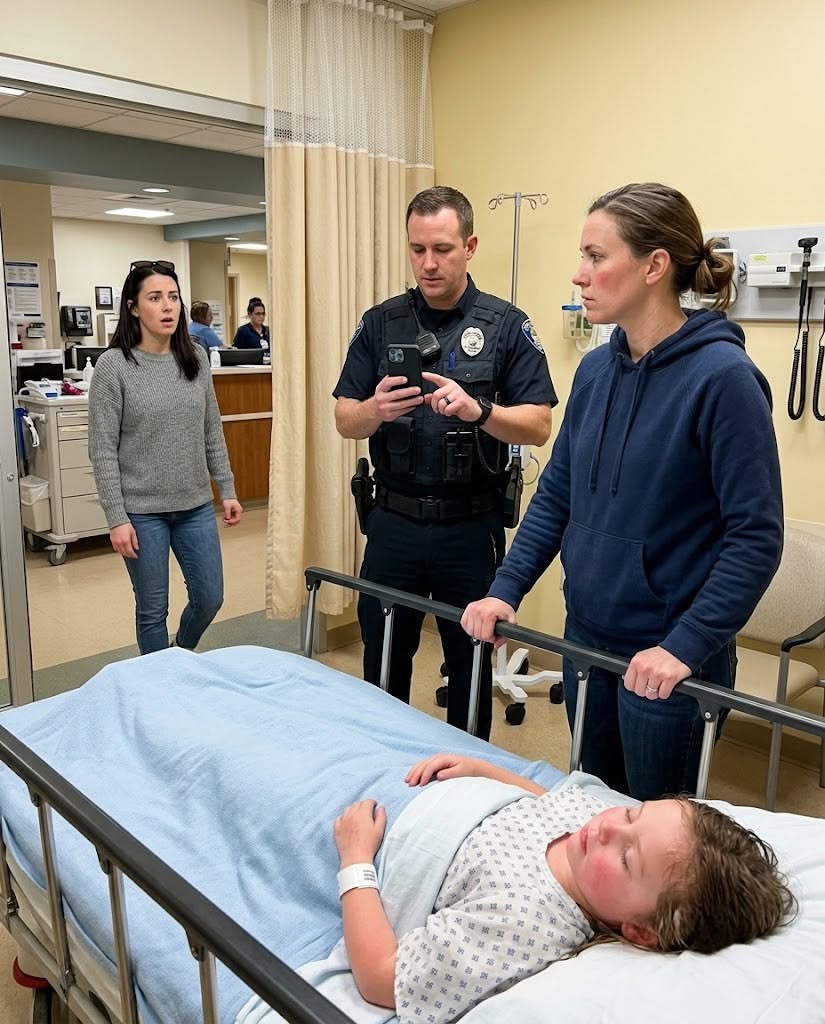
Then the nurse pulled back a curtain, and I saw Ellie.
She was lying beneath a thin hospital blanket with a paper wristband around her small wrist.
Her cheeks were flushed.
Her hair was damp and stuck in soft strands against her forehead.
She looked smaller than she had that morning, and the sight of her hit me harder than the phone call had.
There is something unbearable about seeing your child in a hospital bed when only hours earlier you were worrying about ordinary things like meetings, schedules, backpacks, and whether you remembered to answer an email.
I moved toward her, but I was afraid to touch her too quickly.
The nurse spoke quietly and told me she was resting.
I focused on the rise and fall of Ellie’s breathing because it was the only thing in the room I could understand without asking another question.
Officer Grant was standing near the foot of the bed with a folder in his hand.
I had been so focused on Ellie that I had barely noticed him at first.
When I finally looked at him, his expression told me the conversation I had been dreading was about to begin.
“Your daughter was found locked inside your SUV in the east parking lot near the park entrance,” he said.
I stared at him.
For several seconds, the words did not form a complete picture.
Locked inside.
My SUV.
Near the park.
Alone.
I looked back at Ellie’s flushed face and damp hair.
The steady beeping beside her bed seemed suddenly too loud.
I asked Officer Grant where Rachel was.
Then I asked about my parents.
He said they had been contacted, but none of them had arrived at the hospital yet.
That answer made no sense to me.
If they had been with Ellie when something happened, why weren’t they already there?
If they had somehow been separated from her, why wasn’t Rachel blowing up my phone trying to explain?
Why had an officer reached me before my own family had?
I checked my phone again, almost expecting to see missed calls I had somehow ignored.
Nothing from Rachel.
Nothing from my mother.
Nothing from my father.
So I called Rachel myself.
The phone rang once.
Twice.
Three times.
Four.
On the fifth ring, she answered.
She was laughing.
That sound has never left me.
There was music behind her, children talking, and the sharp rattle of ice in plastic cups.
The background sounded casual, busy, almost cheerful.
For half a second, I wondered if I had misunderstood everything.
Then I said Ellie’s name.
Rachel sighed.
Not gasped.
Not asked whether Ellie was okay.
She sighed like I had interrupted something pleasant.
“She’s fine, Maya. You always make everything dramatic.”
I looked at my daughter lying under the hospital blanket.
I looked at the paper wristband around her wrist.
I looked at Officer Grant.
Then I told Rachel exactly where I was.
I said Ellie was in the hospital.
I said the police had called me.
I said my daughter had been found locked inside my SUV.
Then I asked the only question that mattered.
What happened to Ellie?
There was one second of silence on Rachel’s end.
One second in which I thought maybe she had finally understood the seriousness of what I was saying.
Then she laughed again.
“Honestly? We had such a nice day without her.”
The nurse looked up immediately.
Officer Grant’s expression changed just enough for me to know he had heard every word.
I felt something inside me shift.
For years, I had imagined that if my family ever crossed a line serious enough, I would explode.
I thought I would yell.
I thought I would finally unload every resentment I had swallowed to keep the peace.
But I did not scream at Rachel.
I did not beg her to explain herself.
I did not tell her she was cruel or demand that she apologize.
I looked at Ellie sleeping beneath that hospital blanket, and something old and obedient inside me went cold.
For the first time, I was not thinking about whether Rachel would be angry with me.
I was not thinking about whether my mother would accuse me of overreacting.
I was not thinking about whether my father would call me ungrateful.
I was thinking about the fact that my six-year-old had trusted the adults I gave my keys to.
I ended the call.
Twenty minutes later, Rachel finally walked into the ER.
My parents came in behind her.
The difference between the way they entered and the way I had arrived was almost impossible to process.
I had run into that hospital barely able to sign my own name.
My mother came through the curtain already talking.
She rushed toward Ellie’s bed in a cloud of perfume and panic, but the panic was not directed where I expected.
Instead of asking what the doctors had said or whether Ellie was okay, she demanded to know why I had allowed Ellie to become dehydrated in my own car.
For a moment, I honestly thought I had misheard her.
My own car.
As though ownership of the SUV somehow meant I had been standing beside it when Ellie was locked inside.
As though the fact that the registration carried my name erased the fact that I had handed the keys to Rachel that morning.
Before I could answer, my father muttered that this was what happened when a mother cared more about work than her child.
The accusation landed with a strange familiarity.
It was the same pattern I had lived with for years, only now the stakes were so much higher that I could finally see the pattern clearly.
Something went wrong.
I became responsible.
Someone else crossed a line.
I became dramatic for noticing.
Rachel stayed in the doorway with her sunglasses pushed up onto her head.
She did not move toward Ellie.
She did not ask how she was feeling.
She looked at me instead.
“Maybe now you’ll stop dumping your kid on everyone,” she said.
The words were so disconnected from reality that for a second I had no answer.
Rachel had asked to borrow my SUV.
The plan had been presented as a family day.
My parents had gone with her.
They had all promised me Ellie would have a great time at the park with her cousins.
Now, standing inside the ER, they were rewriting the day while my daughter was still in a hospital bed.
That was when Officer Grant moved.
He opened the folder he had been holding.
The small sound of paper shifting seemed to change the entire room because until that moment, my family had been treating the situation like one more argument they could overpower by speaking louder than I did.
Officer Grant did not argue with them.
He did not match their volume.
He looked down at the report and stated what had been documented.
Ellie Collins, age six, had been found locked alone in a registered vehicle during a heat advisory.
My mother stopped talking.
My father’s attention shifted from me to the folder.
Rachel remained in the doorway.
Below the basic details were four words that changed the tone of the room completely.
Child safety investigation opened.
My mother’s hand closed around the bed rail.
Officer Grant explained that the investigation could affect whether any of them would be allowed unsupervised contact with Ellie again.
He did not promise an outcome.
He did not tell them what the final decision would be.
He simply made it clear that what had happened was no longer a family argument that could be buried under accusations about my job, my parenting, or my personality.
There was now a documented incident involving a six-year-old child found alone inside a locked vehicle during dangerous heat.
For three seconds, Rachel’s smile held.
I watched her face because I wanted to understand how someone could still look amused while Ellie was lying only a few feet away.
Then Officer Grant raised his phone.
“There is a call everyone in this room needs to hear before another statement is made.”
My mother’s fingers tightened around the rail.
My father, who only moments earlier had been blaming me for caring too much about work, stopped speaking completely.
Rachel’s mouth stayed slightly open, but nothing came out.
I looked at Officer Grant’s phone.
Until that moment, I had assumed I already knew the worst thing I was going to hear that day.
Ellie had been left locked in the SUV.
Rachel had laughed when I called from the hospital.
My parents had walked into the ER and blamed me instead of asking what had happened to their granddaughter.
I thought those facts were already enough to understand what kind of day this had been.
But Officer Grant was not holding up that phone simply to repeat something we already knew.
The room had changed because my family understood that too.
My mother was no longer looking at me.
My father was no longer offering explanations.
Rachel, for the first time since walking through the curtain, looked unsure of what she was supposed to say next.
Officer Grant pressed play.
There was a brief burst of ordinary background noise from the recording.
Then a woman’s voice came through the phone speaker.
I knew it immediately.
Rachel.
Clear.
Casual.
Unmistakable.
And the first words she said made the entire argument they had brought into that hospital room collapse under its own weight.
“She’s not family today. She’s your burden.”
