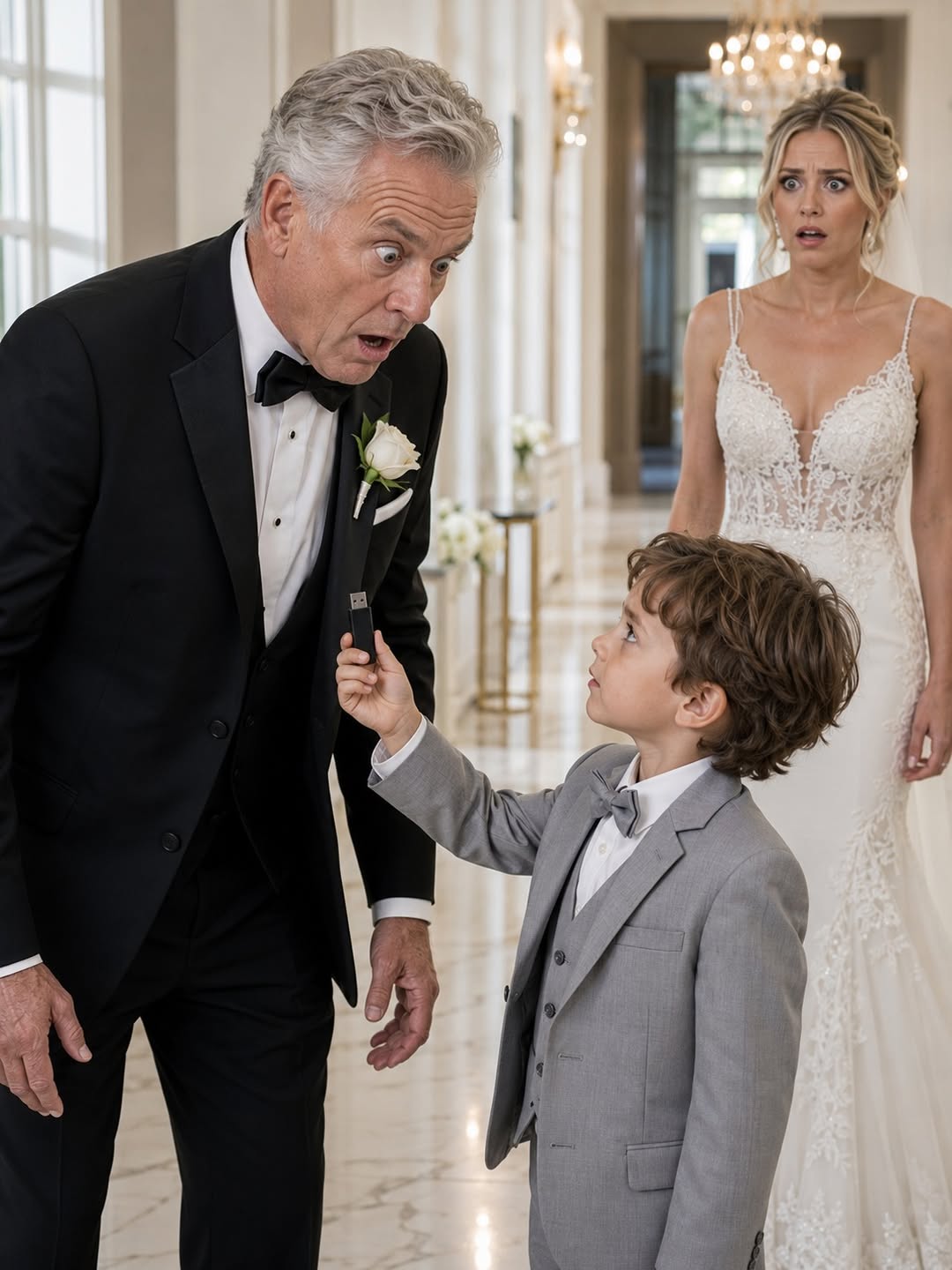
“Grandpa, don’t marry her… she hit my mommy when you weren’t there.”
My name is Thomas Vance, and I stood frozen in the middle of the hotel hallway—ten minutes away from walking into a ballroom where a hundred and twenty guests waited with music, white flowers, and raised champagne glasses.
My three-year-old grandson, Toby, was gripping my hand with an intense, desperate strength. He wore a gray suit that was a size too big, his shoes were untied, and his bowtie sat crooked beneath his chin. But he wasn’t playing. He wasn’t throwing a tantrum. His wide brown eyes were staring toward the door of the bridal suite with a terror that made my blood run cold.
I dropped down to my knees in front of him. “Who hit your mommy, buddy?”
Toby raised a trembling finger and pointed down the hall.
At Evelyn.
The woman I was about to marry.
Evelyn Kensington looked flawless. Draped in ivory lace with a perfect smile, she was laughing alongside her bridesmaids as a photographer adjusted her veil. She appeared radiant, kind, and gentle. This was the same woman who had brought me coffee at my firm for two years, who made me soup when I was sick, and who claimed to love my family as if it were her own.
The ambient noise of the hotel suddenly faded into a dull roar.
My daughter, Genevieve, hadn’t arrived for the ceremony yet. That morning she had texted me saying she had a migraine and might be late. Evelyn had quietly reassured me that Genevieve was simply bitter about me remarrying six years after losing my wife.
“Your daughter doesn’t accept me, Thomas,” Evelyn had sighed softly. “But I’ll be patient. Love takes time.”
I had wanted so badly to believe her.
Now, Toby was hiding behind my leg as if Evelyn were a predator.
“Where is your mommy right now?” I asked softly.
“With Aunt Sarah,” Toby whispered. “Mommy told me not to come with her.”
I swallowed hard. Genevieve was supposed to be resting at her apartment in the city. Sarah, my younger sister, lived across town. None of this made sense.
“Did your mommy tell you anything else?”
Toby looked at Evelyn again, his tiny body trembling. Then he reached his small hand into his suit jacket pocket. He pulled out a tiny black USB flash drive, scratched at the corner.
“She told me if she fell asleep for a long time, I had to give this to you.”
My knees nearly gave out beneath me.
Before I could ask another question, Evelyn turned around. Her smile flickered for a fraction of a second before she glided toward us with that warm, practiced sweetness she always wore in public.
“Thomas, darling, the entrance music is playing. Everyone is asking for you.”
Toby took another sharp step back behind my coat.
I slipped the USB drive into my breast pocket. “I need five minutes.”
Evelyn glanced down at the boy, her eyes narrowing slightly. “What did Toby say to you?”
“Just grandpa stuff.”
“This is no time for games, Thomas,” she said, her voice dropping into a tight, rigid register beneath her smile. “There are guests out there, press, board members from your firm. You can’t leave me standing at the altar.”
“I said five minutes.”
Evelyn studied my face, trying to read me. She reached out to touch my arm, but Toby let out a tiny whimper and cowered further behind me.
“Toby is tired,” I said, my tone flat. “Go back to the suite.”
“Thomas—”
“Go to the suite, Evelyn.”
My voice came out with an authority so cold that her bridesmaids stopped whispering.
I picked up Toby, walked into the dressing room I had used earlier, and locked the door from the inside. With trembling fingers, I booted up my laptop and inserted the drive.
A single folder appeared: EVELYN.
Inside were screenshots of text threads, bank balance statements, forged documents, and a video file recorded from the hallway of my home.
I clicked the most recent video.
On the screen, Genevieve’s shaky camera revealed she was filming secretly from behind a door. Evelyn’s voice rang out, sharp and venomous.
“I warned you to stop interfering, Genevieve.”
“My father has a right to know what you’re planning,” Genevieve replied, her voice trembling.
A loud, sickening slap echoed through the speaker, followed by a heavy crash against a table. Genevieve let out a gasp of pain.
Evelyn’s voice followed, terrifyingly calm: “By the time your father figures it out, the house, the accounts, and every asset he built will already be in my name.”
Furious pounding rattled the wooden door of my dressing room.
“Thomas! Open this door!” Evelyn demanded from the hallway.
Toby covered his ears, pressing his face into my chest.
Looking at the screen, I realized I wasn’t dealing with a nervous bride. I was standing in front of a trap dressed in white—and the mask was about to come off.
PART 2
I closed the laptop, but I didn’t unlock the door.
“Thomas, what are you doing in there?” Evelyn called out, her voice straining to sound pleasant.
“Changing my tie.”
“You’ve changed it twice already!”
“Then this will be the third time.”
Silence lingered outside, followed by the hard, sharp click of her heels retreating down the hall.
I immediately dialed Genevieve’s phone. No answer. I called again. Nothing. Finally, I dialed my sister, Sarah.
“Is Genevieve with you?” I demanded.
There was a long, heavy pause on the line that made my chest tighten. “Yes.”
“Put her on.”
“She’s sleeping, Thomas.”
“Toby told me Evelyn put her hands on her.”
Sarah let out a shaky breath she seemed to have been holding for hours. “You need to come here.”
“Tell me what happened, Sarah.”
“Not over the phone.”
“Sarah!”
My sister’s voice cracked. “Genevieve came to my house at two in the morning. Her lip was split, her wrist was swollen, and she was terrified you wouldn’t believe her. She said Evelyn came to her apartment.”
I closed my eyes, squeezing the bridge of my nose. “Why?”
“Because Genevieve found out about the money. And she found out even more.”
Sarah explained that Genevieve had been suspicious for months. Evelyn had been pushing aggressively for us to combine our assets immediately after the wedding. She kept asking about the deed to my estate, my estate trust, and the private investments I had built over thirty years as owner of my logistics firm.
Genevieve had run a private background check and discovered that Evelyn hadn’t been widowed once, as she claimed. She had been married twice before. Her second marriage in Texas had ended in a messy civil lawsuit involving hidden debts and forged signatures.
“She didn’t serve prison time,” Sarah whispered, “but her ex-husband accused her of completely draining a joint trust.”
A profound wave of shame washed over me. “And the documents on the drive?”
“Evelyn initiated a commercial credit application using your estate as collateral. Genevieve thinks she was going to push you to sign a power of attorney on Monday during your honeymoon.”
Down the hallway, the wedding string quartet began playing the entrance procession.
I called Marcus, my oldest friend, a retired police detective, and my best man. “Get to my dressing room. Now.”
Four minutes later, Marcus walked in. He took one look at my face and skipped the pleasantries. “What’s wrong, Thomas?”
I turned the laptop screen toward him and played the video.
Marcus didn’t even blink. His jaw set into stone. “Don’t confront her alone.”
“I’m going to see my daughter.”
We slipped out through a private side exit. Marcus’s driver navigated through the afternoon traffic toward Sarah’s house while my phone vibrated relentlessly in my hand.
Evelyn was calling. Then came the texts:
Where are you?
Everyone is waiting.
Your daughter is making things up to ruin our day.
I stared at that last message. I hadn’t told her I was going to Genevieve.
Marcus noticed it too. “She knows Toby gave you that drive.”
When we arrived at Sarah’s house, Genevieve was sitting on the couch in sweatpants, her wrist wrapped in a tight brace. Her upper lip was dark and swollen. When she saw me walk through the door, she broke down into tears.
“I’m so sorry, Dad…”
I crossed the room and pulled her into my arms. “No. Forgive me.”
Toby ran to his mother, wrapping his small arms around her waist.
Genevieve handed me her phone. Screened on the display were emails, photos of loan applications, and text exchanges between Evelyn and a man named Julian Sterling.
One message from Evelyn read: Wedding is Saturday. Signatures on Monday. Once the joint trust is executed, we move forward.
Julian had replied: Don’t push him too fast. One suspicious signature ruins everything.
My blood ran cold.
My phone buzzed again with a final text from Evelyn:
If you cancel this wedding, you will regret humiliating me.
Marcus read it over my shoulder. “Keep everything. Save every thread.”
I typed a single sentence back:
The wedding is canceled.
Evelyn replied instantly:
You have no idea what you’ve just started.
PART 3
By 5:00 p.m., the grand hotel ballroom was entirely empty.
The flowers were still fresh, the three-tiered cake remained untouched, and hotel staff were silently clearing place settings. The wedding that was supposed to make Evelyn Kensington my wife had ended before it ever began—stopped by a three-year-old boy carrying a hidden flash drive in his coat pocket.
My brother had handled the guests, offering a brief, polite statement: “There has been a medical emergency within the family. Thank you for coming.”
In high-society circles, when a wedding is canceled minutes before the altar, silence speaks louder than any rumor.
I stayed at Sarah’s house, sitting beside Genevieve while Marcus methodically organized the digital files. He instructed us not to send anything via messaging apps, not to delete a single log, and not to respond to any calls.
“This isn’t a family dispute anymore,” Marcus said firmly. “This is attempted fraud, grand larceny, and felony assault.”
Evelyn called thirty-eight times that evening.
First came the rage: You made a fool out of me in front of everyone!
Then the tears: You can’t do this to me after everything we’ve shared!
Then the venom: Your daughter has been trying to tear us apart from day one!
And finally, panic: Don’t show those files to anyone. They’re private property.
Marcus chuckled softly. “That’s what gave her away. She didn’t ask what files. She already knew.”
At 8:20 p.m., a security alert from my home smart system flashed on my phone. My residence in the suburbs was a wide brick home where I kept my private office and thirty years of financial archives.
Evelyn had just walked through the front door.
She had used the spare key I had given her two months prior. On the foyer camera, she had traded her wedding gown for a dark trench coat, carrying a large leather tote bag over her shoulder.
“She’s in my house,” I said.
Marcus stood up. “Don’t go there. Call the police department right now.”
I dialed 911. While waiting for the patrol cars to dispatch, I watched the live feed as Evelyn walked upstairs into my private study. She stayed inside for eleven minutes, emerging with a locked metal file box.
I recognized that box. It contained copies of my estate trust, tax records, property deeds, and corporate share certificates.
The police arrived before she could reach her car.
One of the officers called my cell. “Mr. Vance, a woman here claims she resides at this address.”
“She does not live there.”
“She claims she is your fiancée.”
“The wedding was canceled today. She does not have permission to remove my property.”
While they couldn’t arrest her for burglary on the spot due to possessing a key, the officers documented the incident, confiscated the metal box, and escorted her off the premises with a formal trespass warning. On the driveway camera, Evelyn’s face was stone-cold as she walked away. She wasn’t crying. She looked like a predator whose prey had slipped out of the cage at the last second.
The next morning, I changed every lock, security code, banking password, and credit authorization tied to my name. I notified my accountants, my corporate legal counsel, and my bank managers.
At noon, my bank flagged an unauthorized attempt to pull a $400,000 line of credit against my estate using my social security number and corporate tax ID. The recovery email address linked to the application belonged to Julian Sterling—Evelyn’s accomplice.
When Genevieve heard the news, she lowered her head. “That’s why I went to her apartment,” she whispered. “I wanted her to admit it before the wedding. I was terrified that if I told you without absolute proof, you’d think I was just being a jealous daughter.”
A heavy wave of guilt washed over me.
I remembered three moments over the past year that now burned in my chest:
When Genevieve had asked why Evelyn was asking detailed questions about my investments, and I told her not to be paranoid.
When Evelyn suggested updating my estate trust to “simplify our future,” and Genevieve urged caution, but I dismissed her concerns.
And two weeks before the wedding, when Genevieve said, “Dad, something doesn’t add up about her background,” and I angrily replied, “I’m sixty-three years old, Genevieve. I know how to manage my own life.”
I hadn’t listened to my daughter. Worse, I had left her exposed to a dangerous woman.
My lead attorney, Raymond Vance, reviewed the USB drive and the police reports. “We have more than enough evidence to secure an emergency restraining order, freeze all joint applications, and initiate criminal proceedings for fraud and assault.”
Genevieve formally expanded her police report, providing forensic photos of her injuries and the text logs between Evelyn and Julian.
Julian Sterling wasn’t a bank officer. He was Evelyn’s cousin and an independent financial broker. When brought in for questioning, he immediately cracked, attempting to cut a deal.
“Evelyn told me Mr. Vance had already agreed to the credit line!” Julian stammered to investigators.
Raymond Vance asked him three simple questions:
“Did Mr. Vance ever speak to you directly?”
“No.”
“Did he sign an authorization in your presence?”
“No.”
“Who supplied you with his private financial documents?”
Julian hesitated before mumbling, “Evelyn.”
Over the next several months, the legal process moved with deliberate, unyielding precision. Evelyn’s legal team tried various tactics—claiming Genevieve had initiated the physical fight, claiming the video was tampered with, and threatening defamation suits.
Raymond didn’t engage in public drama. He simply submitted the mountain of certified evidence to the district attorney.
Nine months after the canceled wedding, Evelyn accepted a felony plea bargain to avoid a lengthy trial. She received probation, substantial financial restitution penalties, and a permanent, legally enforced restraining order prohibiting her from ever approaching Genevieve, Toby, or myself.
My estate, my accounts, and my firm were saved. But the emotional cost remained.
A year later, Genevieve and Toby came over for dinner at my new, smaller home near the coast—a house I had bought after selling the old estate, wanting a fresh start free of surveillance cameras and painful memories.
Toby was playing with a toy train on the living room rug. While he was occupied, I walked out onto the patio with Genevieve.
“Why didn’t you tell me sooner, sweetie?” I asked softly.
Genevieve looked at me, her eyes clear and calm. “I did tell you, Dad. Three times.”
I bowed my head. She wasn’t saying it to hurt me; she was simply stating the truth.
“I was afraid that if I kept pushing, I’d push you out of my life,” she added quietly. “I didn’t want to compete with her. I just wanted you to slow down.”
I took my daughter’s hand in mine. “I made you feel like protecting me would cost you my love. I’m so sorry.”
Tears welled in her eyes, but she smiled, squeezing my hand tightly. We didn’t fix everything that night, but we stopped pretending the crack hadn’t existed.
A few minutes later, little Toby ran out onto the patio, holding his toy train. He looked up at me with his bright brown eyes.
“Grandpa, did I ruin the wedding?”
I knelt down, pulling my grandson into a tight hug. “You didn’t ruin it, buddy. You saved us.”
Toby smiled, satisfied with the answer, and ran back inside to play.
I stood up and looked out toward the sun setting over the trees. I thought about the black flash drive, the white dress, the video in the hallway, and the quiet bravery of a little boy who saved his family when the adults were too blind to see.
Real truth rarely arrives with loud speeches or dramatic court scenes. Sometimes, it comes in the quiet, trembling voice of a child, holding a secret in his pocket, showing you the way back home.
