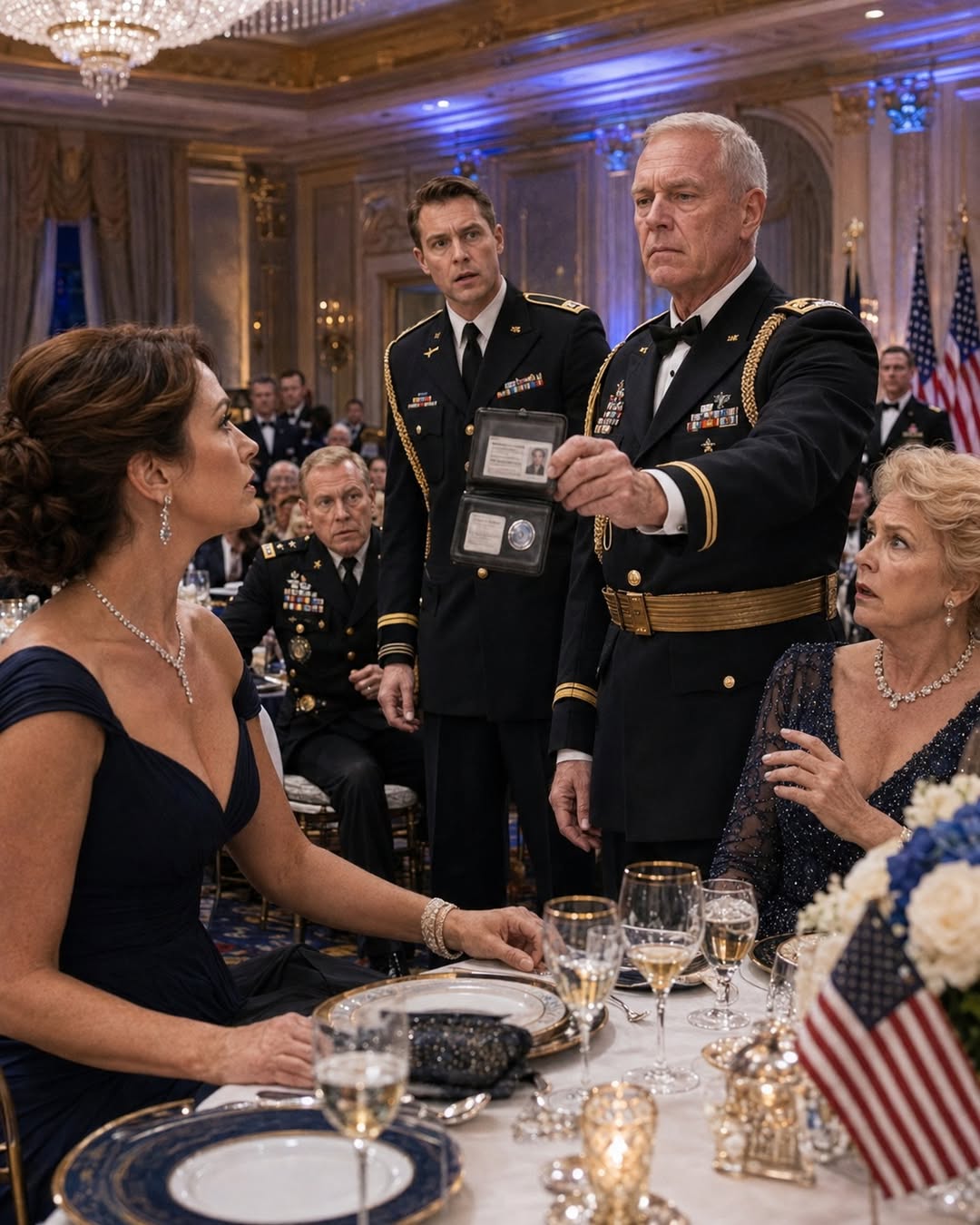
“Yes,” Evelyn said, though the confidence had disappeared from her voice. “I wrote it because somebody needed to verify who she was.”
Caldwell looked down at the tablet again.
“Then I want to be certain you understand what you submitted.”
Evelyn’s jaw tightened.
“I said she didn’t belong here.”
“That isn’t all you said.”
The ballroom had become so quiet I could hear the faint hum from the speakers near the stage.
Ethan moved closer to the table.
“What did she write?”
Caldwell looked at me before answering him.
I understood the courtesy immediately.
The complaint involved my status, my credential, and potentially information I was not free to discuss publicly.
“You may read the relevant portion,” I told him.
Caldwell nodded.
He turned the tablet slightly away from the surrounding tables and read only the section connected to Evelyn’s security allegation.
She had described me as a civilian attempting to impersonate military authority.
Then she had added something worse.
According to Evelyn, I had previously made vague claims about accessing restricted installations and might attempt to enter controlled areas during the event.
The words landed differently from her earlier insult.
This was no longer about a missing name card.
She had transformed things I had said privately inside my marriage into a written security accusation.
Ethan stared at his mother.
“You told them she might be impersonating someone?”
Evelyn lifted both hands.
“How was I supposed to know what those stories meant? She disappears for work and refuses to explain anything.”
I felt something cold settle behind my ribs.
“Stories?” I asked.
She looked at me.
“You know exactly what I mean.”
No, I knew exactly what Ethan had told her.
That realization hurt more than anything Evelyn had done that evening.
My overseas travel, secure facilities, unusual work schedules, and limited answers had not remained between my husband and me.
Caldwell’s aide quietly took the tablet back.
“Mrs. Hawthorne, this complaint entered an official security system,” Caldwell said. “It wasn’t a seating request.”
“I was protecting the event.”
“No,” the older MP said carefully. “You reported a suspected credential fraud and potential unauthorized access attempt.”
Evelyn looked around as if searching for someone who would agree with her interpretation.
Nobody did.
Audrey had stopped beside Ethan, but she was no longer touching his arm.
Her father glanced toward her.
“Audrey,” Caldwell said, “were you involved in filing this complaint?”
Her face changed immediately.
“No, sir.”
“Did you know it had been filed?”
“I knew Mrs. Hawthorne wanted Mara moved from the table. I thought she was speaking to event staff.”
Evelyn turned sharply.
“Audrey.”
Audrey stepped backward.
“I didn’t know you called security.”
That mattered.
For years Evelyn had used Audrey as a comparison, a symbol of the marriage she believed Ethan should have made.
Now even Audrey wanted distance from what Evelyn had done.
Caldwell looked at the MP.
“Was Colonel Mercer’s credential authenticated?”
“Yes, sir.”
“Any discrepancy?”
“None.”
Caldwell nodded once.
Then he addressed the people still standing nearby.
“Everyone may return to their seats. Security has verified the credential.”
Chairs slowly moved across the floor.
The orchestra director received a signal from the event coordinator, though the music did not resume yet.
Caldwell lowered his voice when he spoke to me again.
“Do you want this handled here or outside the ballroom?”
“Outside,” I said.
I had no interest in turning the rest of the evening into a public spectacle.
Evelyn had wanted one.
I didn’t.
The MPs escorted our small group into a carpeted corridor near the ballroom entrance.
Caldwell’s aide followed, along with Ethan and Evelyn.
Audrey remained inside.
Once the doors closed, Caldwell’s posture became less ceremonial and more administrative.
“Colonel, I need to ask one question for the incident record.”
I nodded.
“Did you represent yourself tonight as having authority you do not possess?”
“No.”
“Did you attempt to access any restricted area?”
“No.”
“Did you present your credential before security requested identification?”
“No.”
The MP confirmed each answer.
My credential had remained closed beside my water glass until officers approached me.
That sequence was important.
It meant Evelyn’s complaint had generated the confrontation, not anything I had done.
Evelyn folded her arms.
“So I made a mistake.”
Caldwell looked at her.
“A mistake would have been asking security whether a guest was properly registered.”
She said nothing.
“You made affirmative allegations about conduct you had not witnessed.”
Her face reddened.
“I had reasons.”
“Disliking your daughter-in-law is not a security reason.”
Ethan shut his eyes for a moment.
That was the first time anyone had stated the problem without dressing it up as a misunderstanding.
Evelyn turned toward him immediately.
“Are you going to stand there and let him speak to me like this?”
Ethan opened his eyes.
For several seconds, he said nothing.
I watched him make the same choice he had made at Table Seven.
Avoid conflict.
Make everyone else absorb his mother’s behavior because confronting her was uncomfortable.
Then he looked at me.
“Mara, can we just clear this up?”
Something inside me finally gave way.
“It is clear.”
He frowned.
“I mean between us.”
“Did you tell her about my work?”
His hesitation answered before his mouth did.
“Only generally.”
“What does generally mean?”
“I told her you sometimes went to restricted facilities.”
Evelyn interrupted.
“And that you wouldn’t tell him what you were doing there.”
I kept looking at Ethan.
“What else?”
He rubbed a hand across his face.
“She asked whether you were really still connected to the military.”
“And what did you say?”
“I said I didn’t know.”
That answer explained everything.
Not my credential.
Not my work.
My marriage.
Ethan had treated the boundaries around my assignment as something suspicious because those boundaries made him feel excluded.
Instead of trusting me, he had carried that discomfort to his mother.
She had weaponized it.
Caldwell stepped slightly away, giving us privacy without leaving the corridor.
I appreciated the gesture.
Ethan lowered his voice.
“You never told me you were a colonel.”
“I told you I remained affiliated after leaving regular active duty.”
“You never said this.”
“I told you what I was permitted to tell you.”
My current assignment placed me in a specialized reserve status supporting a federal defense program.
Some details could be shared with family.
Others could not.
My rank was not classified.
But Ethan had stopped asking thoughtful questions years earlier.
Whenever the subject became complicated, he changed it.
Evelyn preferred simpler categories.
General mattered.
Civilian did not.
Visible rank mattered.
Quiet service did not.
So when I refused to perform my résumé for her, she decided there was nothing worth respecting.
The irony was almost embarrassing.
I had spent years protecting information from people with legitimate curiosity.
The person who broke my trust was my husband, trying to make conversation with his mother.
Caldwell returned after speaking quietly with the security officer.
“Mrs. Hawthorne, you’ll need to leave the event tonight.”
Evelyn stared at him.
“You’re throwing me out?”
“You’re being removed from the event because your complaint disrupted security operations and contained unsupported allegations.”
Her mouth opened.
Caldwell continued before she could speak.
“This is not an arrest.”
That distinction mattered too.
Nobody dragged her away.
Nobody put her in handcuffs.
Nobody turned the corridor into theater.
The security office would document the incident and review whether her future guest access required additional approval.
That was procedure, not revenge.
Evelyn looked toward Ethan.
“You’re coming with me.”
It was not a request.
For most of our marriage, he would have obeyed automatically.
This time he stayed where he was.
“No.”
Evelyn blinked.
“What?”
“I’m not leaving with you.”
Her shock would almost have been funny in another life.
“You’re choosing her after she lied to this family?”
Ethan’s expression changed.
“She didn’t lie.”
“You didn’t even know who she was.”
That sentence found its target.
Ethan looked at me.
Neither of us denied it.
Caldwell signaled the MPs.
They escorted Evelyn toward the lobby so she could collect her wrap and arrange transportation.
She never apologized.
Before turning the corner, she looked back at me.
“This is exactly why you were wrong for him.”
I expected anger.
Instead, I felt tired.
“You may be right about one part of that,” I said.
Ethan heard me.
His face went still.
After Evelyn disappeared, Caldwell handed my credential back once more.
“I’m sorry your evening became an incident report.”
“So am I.”
He gave Ethan a long look but offered no lecture.
That restraint carried more weight than a speech would have.
Then he returned to the ballroom.
Ethan and I remained in the corridor.
Through the doors, the orchestra finally resumed.
For a moment neither of us moved.
“I should have defended you at the table,” he said.
“Yes.”
“I should have stopped Audrey from taking my arm.”
“Yes.”
“I should never have discussed your work with my mother.”
“Yes.”
Each answer seemed to hurt him more because I wasn’t yelling.
He leaned against the wall.
“I thought you were being secretive because you didn’t trust me.”
“I was following restrictions.”
“I know that now.”
“No, Ethan. You knew enough before tonight.”
He looked at me.
That was the truth we had both avoided.
He knew I had served twelve years.
He knew there were things I could not discuss.
He knew his mother humiliated me repeatedly.
What he lacked was not information.
It was courage.
I picked up my clutch from the chair an aide had brought into the corridor.
Ethan watched me.
“Are you leaving?”
“Yes.”
“I’ll come with you.”
“No.”
His face tightened.
“Mara.”
“You should stay.”
“Why?”
“Because this is your command’s event, and walking out with me would make another scene.”
I paused.
“And because I need one evening where your discomfort is not something I have to manage.”
He looked down.
I left alone.
The next morning, Ethan came home shortly after seven.
I had slept in the guest room.
He found me at the kitchen counter drinking coffee.
For once, he did not begin with an explanation.
He placed his phone on the counter.
“I told Mom she can’t come here until you say otherwise.”
I looked at him.
“That is a start.”
“I also told her I won’t discuss your work, our marriage, or anything you tell me privately.”
“Another start.”
He swallowed.
“But it doesn’t fix what I did.”
“No.”
We sat in silence.
Then he said the sentence I had needed from him long before any general entered the picture.
“You shouldn’t have needed a credential for me to respect you.”
That one nearly broke me.
Not because it solved anything.
Because he finally understood what had happened.
The insult was never that Evelyn thought I lacked status.
The insult was that Ethan had allowed her respect for me to depend on status at all.
We did not repair our marriage that morning.
I refused to turn one moment of insight into instant forgiveness.
Ethan moved into the guest room.
We began counseling several weeks later, after I made clear that attendance alone would not count as change.
He needed boundaries with his mother whether I stayed married to him or not.
Evelyn’s access review proceeded separately.
I was interviewed once by security personnel and provided a statement limited to the complaint itself.
The electronic record made the important facts simple.
She had submitted the allegation.
She had identified me by name.
She had claimed conduct she never witnessed.
Security had verified my credentials and found no unauthorized activity.
Her future access to invitation-only installation events was restricted pending command approval.
There was no dramatic prosecution.
There did not need to be.
Consequences are sometimes quieter than humiliation.
They can still be real.
Audrey sent me a short message two days after the ball.
She apologized for participating in Evelyn’s constant comparisons and for taking Ethan’s arm after seeing how I had been treated.
I believed her.
I did not become her friend.
Both things could be true.
Caldwell never discussed my assignment publicly.
That mattered more to me than the moment he called me colonel.
He understood what Evelyn never had.
Professional respect sometimes means knowing when not to announce what you know.
Three months later, Ethan and I attended another formal event together.
It was smaller, held at an officers’ club conference room rather than a ballroom.
Before we entered, he stopped beside the door.
“If anyone asks what you do, what should I say?”
I looked at him.
“What would you say now?”
He thought for a moment.
“My wife served twelve years, and she currently does defense work she can discuss when she chooses.”
I nodded.
“That works.”
He opened the door.
Nobody saluted me.
Nobody confronted us.
Nobody needed to.
For the first time in years, Ethan introduced me without minimizing me and without turning me into a résumé.
Later that night, he mentioned his mother only once.
She had asked whether she could apologize to me in person.
I told him I was not ready.
He did not negotiate.
He simply said, “Okay.”
That answer told me more about our future than any apology Evelyn could have offered.
I still carried the black credential holder when my work required it.
But I stopped thinking of it as the thing that changed the night of the ball.
It had only exposed what was already there.
Evelyn believed authority made a person worthy of respect.
Ethan had spent too long accepting that rule because challenging his mother felt harder than disappointing his wife.
The MPs corrected Evelyn’s mistake in minutes.
The harder correction belonged to Ethan.
And unlike a credential check, there was no device that could authenticate whether he had really changed.
Only time could do that.
So I gave him time, but not the old version of my patience.
I stopped smoothing over insults.
I stopped explaining his silence for him.
I stopped accepting peace that required me to disappear inside my own marriage.
Whether we remained together would depend on what he did after the ballroom stopped watching.
That was the part Evelyn never understood.
The most important rank I held that night was not printed inside my credential.
It was the authority to decide what I would tolerate once I walked out the door.
