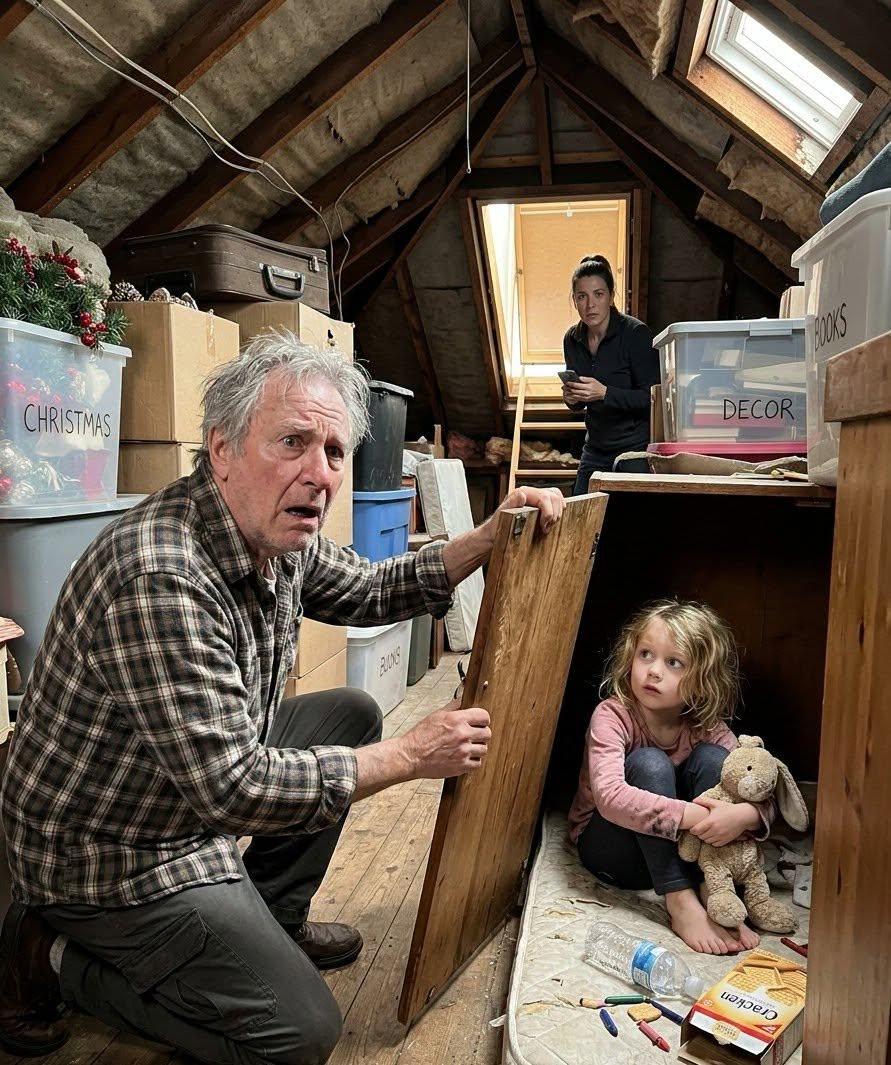
My son locked his five-year-old daughter inside the attic, flew to Hawaii with his wife, and left her with nothing but a box of crackers and half a bottle of water.
They believed no one would discover her.
Then the woman I hired to clean the house heard a child crying behind an old wooden wardrobe.
For nearly four years, Dennis and Trisha had lived in the Portland house I owned without paying a cent in rent.
For the last eighteen months, they had barely allowed me inside.
I kept telling myself there were reasonable explanations.
Dennis was busy.
Trisha valued her privacy.
Married couples needed boundaries.
Parents were supposed to give their adult children room to build their own lives.
But those explanations became harder to accept every time Dennis ignored my calls or came outside to speak with me instead of inviting me through the front door.
I was his father.
Yet lately, I felt less like family and more like a landlord they tolerated because I had never demanded rent.
Then, on June 3, Dennis called.
His name appeared on my phone shortly after breakfast, and for one brief moment, I felt something close to hope.
Maybe he wanted to talk.
Maybe he finally wanted to repair the distance between us.
I answered.
“Dad, can you hire someone to deep-clean the house while we’re gone?”
That was it.
No greeting.
No conversation.
Just another favor.
And, like an idiot, I said yes.
That is the humiliating part of loving your only child.
Even when he treats you like an employee, some part of you still wants to believe that answering his call means something.
Dennis explained that he and Trisha were leaving town and wanted the house cleaned before they returned.
He did not tell me much about their trip.
He didn’t say where they were staying or why the cleaning had to happen while they were gone.
He simply gave me instructions.
Find someone.
Unlock the house.
Pay them.
Make sure everything was ready when they returned.
I had spent years turning rejection into something easier to swallow.
I called it generosity when I let them live in my house rent-free.
I called it patience when Dennis stopped answering my messages.
I called it respect when Trisha made it clear that surprise visits were unwelcome.
Eventually, I became very good at changing the names of things so they hurt less.
I hired Rosa Martinez.
I trusted Rosa completely.
She had cleaned for me before and was careful, reliable, and straightforward. She was not the kind of person who exaggerated problems.
If Rosa told me something was wrong, I believed her.
The following morning, I met her at the house.
The driveway was empty.
Inside, everything looked strangely untouched.
Trisha’s white furniture stood beneath framed vacation photographs. Decorative objects were arranged perfectly. The countertops were spotless.
The house looked less like someone’s home and more like a property prepared for a magazine photograph.
There were no toys near the sofa.
No tiny shoes beside the door.
No drawings on the refrigerator.
Nothing suggested a child had ever lived there.
I unlocked the door, showed Rosa where the cleaning supplies were, and left.
Less than an hour later, my phone rang.
It was Rosa.
Her voice was barely above a whisper.
“Mr. Stanley, you need to come back. Right now.”
I straightened.
“What happened?”
“There is a child crying in the attic.”
For several seconds, I simply stared at the phone.
Dennis did not have a child.
At least, not that he had ever told me.
“Are you sure?”
“I heard her.”
Rosa’s voice trembled.
“Please come back.”
I drove faster than I should have.
By the time I reached the house, every ordinary explanation had fallen apart.
Maybe a neighbor’s child had wandered inside.
Maybe the sound was coming from outside.
Maybe Rosa had mistaken an animal for a child.
But none of those possibilities explained the fear in her voice.
When I pulled into the driveway, Rosa was waiting on the porch with her phone clutched in both hands.
She looked relieved to see me.
“I didn’t touch anything,” she said immediately. “I didn’t know what was happening.”
I stepped inside.
The house was silent.
The air conditioner hummed softly.
Sunlight stretched across the pale floor.
Family photographs lined the walls, showing Dennis and Trisha smiling on vacations I had never been invited to.
Then I heard it.
A faint, broken sound above the hallway.
Not a scream.
A child trying desperately not to be heard.
I pulled down the attic ladder.
Heat rushed over me as I climbed.
The attic smelled of dust, cardboard, and trapped summer air.
Storage containers filled most of the space. Old suitcases and Christmas decorations were stacked along the rafters.
Near the far end stood a narrow wooden wardrobe.
It had been pushed behind several boxes and decorations so completely that someone entering the attic might never have noticed it.
Then I heard the crying again.
It was coming from inside.
My hands began to shake as I reached for the door.
The wardrobe opened with a dry scrape.
A little girl was sitting on a thin mattress with her knees pulled tightly against her chest.
She wore a faded pink shirt.
Beside her sat a stuffed rabbit, two broken crayons, a box of crackers, and a half-empty bottle of water.
There was no fan.
No accessible window.
No bathroom.
And even if the wardrobe had been open, there was no safe way for a five-year-old to climb through the crowded attic and reach the ladder alone.
She looked about five.
I had spent almost four decades working in social services.
I knew that kind of stillness.
Children learn it when they believe making noise will bring punishment.
She did not run toward me.
She didn’t cry louder.
She simply stared at me, trying to decide whether being found was safer than staying hidden.
I crouched several feet away.
“My name is Elmer,” I said softly. “I’m not going to hurt you.”
Her fingers tightened around the stuffed rabbit.
“Are you the cleaning lady’s friend?”
“Yes.”
I paused.
“You don’t have to be quiet anymore.”
The words seemed to frighten her.
She had clearly been given a rule.
And she had learned that breaking rules came with consequences.
“What is your name?”
“Sophie.”
Her voice was almost inaudible.
She told me she was five.
Almost six.
I asked who had told her to stay there.
She rubbed her thumb against her finger.
“My daddy.”
Every instinct I had told me not to ask anything else until the police arrived.
But I already knew what the next question would be.
“What is your daddy’s name?”
She looked directly into my eyes.
“Dennis.”
My son.
My only child.
He had hidden his own daughter inside the attic of the house I owned and then flown to Hawaii with his wife.
For several seconds, I couldn’t hear anything except my own heartbeat.
Suddenly, every memory of the previous few years looked different.
Every time Dennis complained that I asked too many questions.
Every holiday when he and Trisha had been unavailable.
Every time he stood in the doorway and kept me from seeing deeper into the house.
I had believed I was respecting his privacy.
Now I wondered whether I had been helping him hide something.
Sophie’s water bottle was nearly empty.
The crackers had been crushed into crumbs.
I had no idea how long she had been confined there, and I wasn’t going to frighten her with too many questions.
I held out my arms.
“Can I carry you downstairs?”
She looked toward the attic opening.
Then she nodded.
When I lifted her, she wrapped both arms around my shirt.
She barely made a sound.
She felt far too light.
Rosa called 911 while I carried Sophie downstairs and placed her carefully on the couch.
Above her was an entire wall of family photographs.
Dennis and Trisha appeared in nearly every one.
Beach vacations.
Christmas dinners.
Anniversaries.
Champagne.
Smiling faces.
Perfect memories.
Sophie was nowhere in them.
She stared at the photographs without asking who they were.
That frightened me almost as much as the attic.
The paramedics arrived first.
Police followed shortly afterward.
One paramedic knelt beside Sophie and spoke softly while another checked her condition.
An officer climbed into the attic.
When he came back down, something in his expression had changed.
He called another officer over.
Together, they returned upstairs carrying a camera and evidence bags.
They photographed everything.
The wardrobe.
The mattress.
The crackers.
The water bottle.
The crayons.
The path through the storage bins.
Nothing about their behavior suggested they believed this was a misunderstanding.
Then Sophie said something that stopped everyone.
“Daddy said the lady in the pictures would be angry if she knew I was here.”
Her eyes had settled on one particular photograph.
Trisha.
An officer crouched beside her.
“Which lady?”
Sophie pointed.
“That one.”
Trisha.
A second layer to the story had just appeared.
Sophie hadn’t simply been hidden from visitors.
According to what she had been told, she had been hidden from Dennis’s wife.
Whether Trisha truly knew nothing, knew part of the story, or had helped create it was unclear.
The officers did not speculate.
They asked careful questions and recorded Sophie’s exact words.
One officer turned toward me.
“Do you own this house?”
“Yes.”
“Can you prove it?”
I handed him my identification and explained that the deed was in my name.
Then I remembered something else.
The exterior security cameras.
Dennis had never asked me to transfer control of them.
The system still backed up to an account I controlled.
I opened the app on my phone.
There were weeks of recordings.
Most showed ordinary activity.
Cars arriving.
Packages being delivered.
Dennis taking out trash.
Trisha leaving and returning.
Then I found the footage from three nights earlier.
Dennis appeared in the garage.
A little girl in a pink shirt walked beside him.
Sophie.
In his other hand was the same stuffed rabbit we had found beside her mattress.
One ear bent forward.
A dark patch on one paw.
There was no mistaking it.
The recording showed Dennis leading Sophie toward the door near the attic stairs.
It did not capture him putting her inside the wardrobe.
But it established something just as important.
He had brought her into the house.
The date and time were visible.
I sent the original footage to the officer.
He began downloading it while another officer documented the camera system.
I looked over at Sophie.
She had pulled the rabbit tightly against her chest.
A paramedic gave her small amounts of water and continued speaking to her in a calm voice.
I had spent decades helping families survive moments when terrible truths arrived without warning.
I had sat beside parents who discovered what had happened to their children.
I had watched grandparents step in when their own children failed.
I thought professional experience had prepared me for almost anything.
It had not prepared me to watch my own son on a security recording.
Then my phone rang.
Dennis.
His name appeared on the screen.
I answered on speaker.
“Dad,” he said sharply, “why are there police cars outside the house?”
He didn’t ask about Sophie.
He didn’t ask whether anyone was hurt.
He asked about the house.
I looked at the little girl on the couch.
“Your daughter is safe.”
The line went completely silent.
Then I heard Trisha shouting somewhere behind him.
“He found her?”
Those four words changed everything.
She knew there was someone to find.
Whether she knew exactly where Sophie had been kept was still unclear.
But she knew.
Dennis immediately started talking.
“Dad, this isn’t what it looks like. Don’t tell them anything until I explain.”
“You left a five-year-old in an attic.”
“She had food,” he said quickly. “We were handling it.”
Handling it.
As though a child could be stored somewhere out of sight and reduced to a problem that needed managing.
Sophie flinched when she heard his voice.
It was subtle.
But everyone in the room noticed.
Something inside me broke.
For years, I had treated Dennis’s behavior as a phase.
I had convinced myself that patience would eventually restore the relationship we once had.
But the man on that phone was not asking whether his daughter was safe.
He was asking me to protect him.
“Come home,” I said.
He exhaled.
“Good. We’ll straighten this out as a family.”
I looked at the deed folder Rosa had retrieved from my locked desk.
Then I looked at the officer downloading the security footage.
Finally, I looked at Sophie holding the rabbit Dennis had carried into the house.
“No,” I said. “You’re coming home to explain this to the detective.”
His voice hardened.
“Dad, listen to me.”
I let him keep talking.
I didn’t argue.
I didn’t threaten him.
I simply let the officers hear what happened when Dennis realized I was no longer willing to protect him.
Behind him, Trisha began demanding answers.
Their voices overlapped until an officer gestured for me to end the call.
Before I could, another officer entered the living room holding a sealed evidence bag.
Inside was a birth certificate.
He explained that they had found it beneath the mattress in the attic.
The document had been positioned where Sophie couldn’t easily reach it but where someone could retrieve it later.
The officer held the bag up.
Dennis Stanley was listed as the father.
There was no longer any question about whether Sophie had misunderstood his name.
My son was legally identified as her father.
But then the officer read the mother’s name.
The room went silent.
Trisha screamed through the phone.
The detective slowly lowered his eyes from the birth certificate and looked at me.
I stared at the name printed beneath the plastic.
I couldn’t understand why that single name had caused Trisha to scream.
And I couldn’t understand why the detective was now looking at me as though the document had revealed something about my own family that I had never known.
For the first time that day, I realized finding Sophie might not have been the end of the mystery.
It might have been the beginning.
